






















The government of Bulgarian Prime Minister Rosen Zhelyazkov has resigned following widespread protests across the nation, culminating in significant demonstrations in Sofia on Wednesday night. This decision comes just ahead of a scheduled vote of no confidence in parliament and a mere 20 days before Bulgaria is set to join the eurozone.
The resignation reflects the escalating public discontent with the government, which has been accused by demonstrators of systemic corruption. As thousands filled the streets, their demands for accountability became impossible for Zhelyazkov’s minority center-right administration to ignore.
Why It Matters
This political upheaval is significant not only for Bulgaria but also for the stability of the broader region. The country has long struggled with perceptions of corruption, ranking among the highest in Europe according to Transparency International. Zhelyazkov’s departure may signal a shift in governance as Bulgaria prepares for a critical transition to the euro, raising questions about the future of its political landscape.
Key Developments
- Zhelyazkov resigned amid mounting protests against his government over allegations of corruption.
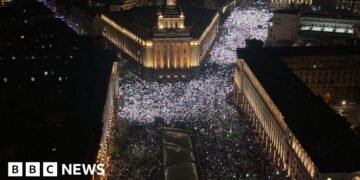
- Demonstrators, numbering between 50,000 and 100,000, gathered in Sofia’s Triangle of Power and Independence Square, calling for the government to step down.
- The outgoing prime minister acknowledged the protesters’ concerns during a televised address, emphasizing the need for civic engagement.
- The government will remain in place until a new cabinet is formed.
- Previous votes of no confidence had allowed Zhelyazkov to remain in power, but widespread anger over corruption may have changed the political calculus.
Full Report
On Wednesday evening, demonstrators expressed their dissatisfaction with Prime Minister Rosen Zhelyazkov’s government, gathering in central Sofia to voice their demands for resignation. The protesters projected messages such as “Resignation” and “Mafia Out” onto the parliament building, underscoring their frustrations with the ruling minority center-right coalition, which has been in power since January.
In a televised address, Zhelyazkov acknowledged the protests, stating, “We hear the voice of citizens protesting against the government,” and emphasized the importance of supporting the civic energy displayed by the crowd. Despite surviving five previous no-confidence votes, the ongoing demonstrations placed considerable pressure on his administration.
Please note that the crowds were notably mobilized against two influential figures in Bulgarian politics: oligarch Delyan Peevski and former Prime Minister Boyko Borissov, both of whom have drawn significant criticism from the public. Peevski, in particular, has faced sanctions from the U.S. and U.K. for alleged corruption.
President Rumen Radev had also supported the call for the government’s resignation, reinforcing the backdrop of political instability. As Bulgaria gears up to join the eurozone on January 1, concerns over corruption and governance remain crucial issues for the public and the incoming administration.
Context & Previous Events
The Zhelyazkov administration has faced increased scrutiny since its establishment, particularly regarding allegations of corruption that have pervaded Bulgarian politics for years. Zhelyazkov’s Gerb party was previously led by Boyko Borissov, who served as Prime Minister when mass anti-corruption protests led to his resignation in 2020. The current political atmosphere has been marked by repeated elections, with Bulgaria undergoing seven since Borissov’s departure, indicating a turbulent political landscape.