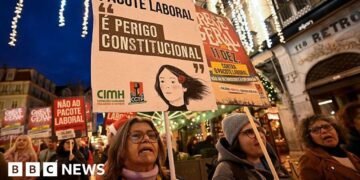























Portugal Faces Major Disruption as Unions Launch General Strike Over Labor Reforms
Portugal is experiencing significant disruption on Thursday as numerous sectors, including transport, healthcare, and education, participate in a general strike initiated by the nation’s two main union federations. This labor action arises in response to proposed labor reforms that critics argue would undermine workers’ rights.
Why It Matters
The unfolding events highlight tensions surrounding proposed labor reforms in Portugal, amidst a backdrop of economic growth. With unions uniting against changes perceived as favoring employers over workers, this strike could signal a pivotal moment in the country’s labor landscape, affecting future governance and workers’ rights.
Key Developments
- General Strike Launched: Both the General Confederation of Portuguese Workers (CGTP) and the Unified General Workers’ Union (UGT) are on strike, marking a rare partnership between the unions since the eurozone debt crisis in 2013.
- Proposed Labor Reforms: Prime Minister Luís Montenegro’s reforms include extending the duration of temporary contracts, allowing dismissals with immediate rehire via outsourcing, and eliminating reinstatement for unfairly dismissed workers.
- Mixed Reactions: The reforms have sparked differing opinions among young professionals, with some supporting the need for change while others express concern over job security.
- Political Landscape: Montenegro’s minority government faces challenges in securing parliamentary support, relying on alliances with smaller and hard-right parties.
Full Report
Strike Overview
On Thursday, Portugal’s transport systems, healthcare facilities, and educational institutions were largely disrupted as workers united to express their opposition to the proposed labor reforms promoted by Prime Minister Luís Montenegro’s right-of-center government. The strike reflects deep-seated concerns among the workforce regarding job security and workers’ rights amid economic reforms.
Government Response
Prime Minister Montenegro has emphasized the necessity of these reforms, stating that they aim to alleviate "rigidities" in the labor market, thereby enhancing corporate profitability and improving worker salaries. "I will not give up on having a country with the ambition to be at the forefront," he declared prior to the strike. However, the prime minister has also faced unexpected backlash from within his coalition, including dissent from members aligned with the UGT.
Union Perspectives
The CGTP has denounced the proposed reforms as detrimental to workers’ rights, particularly affecting young and female employees. UGT leaders have criticized the government for skewed negotiations that seemingly favor employer interests over those of the workforce, labeling the dialogue as "unbalanced and restrictive."
Young Workers’ Opinions
Among young professionals, reactions to the proposals are mixed. Diogo Brito, an air steward, acknowledges the necessity of reforms for Portugal’s economic advancement but also supports the right to strike. In contrast, self-employed photographer Eduardo Ferreira expresses concern about job security for many of his peers, viewing the unions’ collective action as crucial at this "critical moment."
Political Alliances
Montenegro’s coalition lacks a parliamentary majority, requiring the support of smaller parties like the Liberal Initiative and the hard-right Chega to advance the labor reforms. Chega’s leader, André Ventura, has voiced hesitations about the potential impact on family life but remains open to negotiations.
Context & Previous Events
The last collaborative strike by the CGTP and UGT took place during the eurozone debt crisis in 2013 when austerity measures were imposed following a bailout. Since then, Portugal’s economy has seen growth, yet many citizens remain skeptical of reforms that could dismantle fundamental worker protections established in the 1976 constitution. Concerns regarding potential amendments to labor laws and constitutional safeguards have emerged, creating further political tension as the country prepares for January’s presidential elections.






