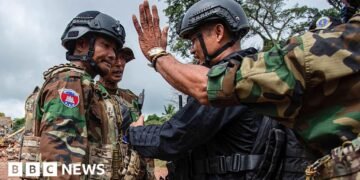























Renewed Violence Erupts Along Thai-Cambodian Border After Failed Ceasefire
Recent artillery exchanges and airstrikes have reignited conflict along the Thai-Cambodian border, as both nations accuse each other of violating a ceasefire brokered by the U.S. earlier this year. The renewed hostilities come just five months after both countries were pushed into a temporary peace by international pressure, leaving local civilians once again displaced.
Why It Matters
The flare-up of violence marks a significant escalation in a long-standing territorial dispute that has displaced over half a million residents from both nations. This conflict poses a broader threat not only to regional stability but also to international diplomatic efforts in the area, raising questions about the efficacy of external mediation in resolving deep-seated tensions.
Key Developments
-
Artillery Engagement: The renewed fighting was sparked by an incident on Sunday involving a Thai engineering team near a disputed area, reportedly fired upon by Cambodian troops, resulting in two Thai soldiers sustaining injuries.
-
Casualties and Displacement: Civilians from communities near the border are once again evacuated, facing uncertainty as they seek refuge from ongoing clashes that have become increasingly lethal.
-
Military Strategy Shift: Thailand’s military has been given broader authority to engage aggressively against Cambodia, aiming to secure strategic positions and counteract perceived threats.
- Cambodian Military Actions: Reports indicate that Cambodia has introduced new landmines along the border, resulting in injuries to Thai soldiers and further escalating tensions.
Full Report
Renewed Clashes
Following an uptick in hostilities, artillery, missiles, and airstrikes have been reported along the border, prompting the evacuation of local villages. Families are finding themselves in temporary shelters, anxious over the instability of their homes. The latest escalation can be traced back to a minor skirmish on Sunday, where a Thai team was allegedly attacked while working on an access road.
Diplomatic Failures
The fragile ceasefire established in July by U.S. diplomatic intervention has collapsed. Thailand, under pressure due to impending tariff negotiations with the U.S., had reluctantly agreed to cease hostilities, while Cambodia welcomed the international engagement. However, longstanding mistrust between the two nations has made efforts toward dialogue ineffective.
Military Actions and Responses
In contrast to diplomatic appeals, military actions have ramped up significantly. The Thai government, led by Prime Minister Anutin Charvirakul, is allowing military leaders considerable latitude in addressing the border conflict. The military aims to sustain pressure on Cambodian forces, focusing on strategic territories and infrastructure, amidst a growing public sentiment favoring a hard-line stance against Cambodia.
Cambodia’s response has been characterized by ongoing aggressive military maneuvers, including the laying of landmines, leading to severe injuries among Thai soldiers. This has prompted Thailand to accuse Cambodia of bad faith and stoked nationalist sentiments within its military and population.
Political Underpinnings
Cambodian leadership, under the influence of former Prime Minister Hun Sen, has struggled to maintain a balance. While publicly advocating for restraint, internal decisions have exhibited a willingness to engage in tactics that provoke the Thai military. This delicate political landscape has also been affected by revelations of leaked communications, further complicating diplomatic relations.
Context & Previous Events
The ceasefire negotiated in July was seen as a precarious arrangement; both nations entered negotiations under duress related to trade tariffs imposed by the U.S. Thailand’s reluctance to include international mediators highlighted its desire to maintain sovereignty over the conflict. In contrast, Cambodia’s favorable view of foreign intervention reflects its position as the smaller nation in a disproportionate power dynamic.
In summary, the latest developments along the Thai-Cambodian border illustrate deep-seated tensions and the challenges of effective conflict resolution in a landscape marred by mistrust, historical grievances, and external political pressures.