






















Republicans Gain Ground in Redistricting Ahead of 2026 Elections
With a recent Supreme Court ruling favoring Texas Republicans, the GOP is poised to gain a tactical advantage in the upcoming 2026 election cycle through strategic redistricting efforts. The decision allows a congressional map, which may add five Republican seats, to advance despite findings of racial gerrymandering by a lower court. This ruling is part of an ongoing nationwide redistricting initiative that began under former President Trump, aimed at bolstering Republican control of the House of Representatives.
Why It Matters
This redistricting battle has significant implications for both parties. A Republican gain in congressional seats could solidify their majority in the House, thereby enabling them to advance their legislative agenda while potentially obstructing Democratic initiatives. As the current Congress sits with a slender Republican majority of 220 to 213, the stakes are high for both parties as elections loom.
Key Developments
- The Supreme Court’s approval allows the Texas GOP’s congressional map to proceed.
- The decision could result in an increase of five seats for Republicans, enhancing their legislative influence.
- Redistricting efforts in Indiana, Missouri, and Florida are concurrently making headlines, with states gearing up for strategic map adjustments.
- Democrats in California have countered with a proposal that could flip five Republican-held seats.
- Ongoing state legislative actions and pending court challenges could further impact the redistricting outcomes.
Full Report
Redistricting Drama in Texas
The Texas congressional map, backed by Republican lawmakers, is under scrutiny after a lower court suggested it may represent a racial gerrymander. In a summer-long standoff, Democrats attempted to delay the map’s approval but ultimately saw the Supreme Court permit its advancement following Trump’s push for five additional GOP seats. The ruling underscores a broader trend of aggressive redistricting efforts since the 1960s, catalyzed by Trump’s call to solidify Republican power.
Aligning Strategies Across States
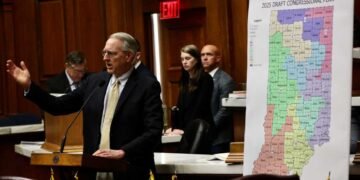
As Texas takes center stage, other states are navigating their redistricting battles. Indiana’s legislature is moving forward, projecting a possible gain of two seats for Republicans, while Missouri faces petitions that could delay redistricting until a public vote occurs. Florida’s GOP is also engaging in redistricting discussions with aims to secure up to five additional seats. These efforts reflect a coordinated strategy among Republicans to capitalize on state-level control over redistricting processes.
In California, Democrats are making progress with a redistricting map targeting five seats currently held by Republicans. This highlights the ongoing tug-of-war as both parties seek to maximize their influence through strategic map-making.
Challenges within Republican Ranks
In Indiana, some GOP lawmakers have expressed hesitance about adhering to Trump’s directives on redistricting, leading to potential internal conflict. The specter of primary challenges looms for those not aligning with the party’s aims. Moreover, several lawmakers report facing anonymous threats, raising concerns about the safety and integrity of the redistricting process.
Legal Landscape and Implications
Redistricting is further complicated by various legal frameworks. States dominated by Democrats, such as California, face barriers to partisan gerrymandering; some require independent commissions to draw maps. Conversely, recent rulings and legislative actions indicate that Republicans have more latitude in shaping electoral districts.
In Florida, legal constraints exist against partisan gerrymandering and racial gerrymandering, yet the Supreme Court is currently examining the Voting Rights Act, which could open the door for more lenient redistricting practices favoring Republicans.
Context & Previous Events
Historically, states would typically reset their congressional maps shortly after the U.S. Census, reflecting demographic changes. In past decades, redistricting efforts were common, but the political dynamics shifted significantly following Trump’s involvement, creating an environment reminiscent of the contentious practices seen in the 1960s.
Debates surrounding redistricting have intensified, especially following President Trump’s advocacy for Republican gains in congressional representation. With critical elections set for 2026, the redistricting landscape remains a pivotal battleground for both parties as they strategize for future electoral successes.






