






















NATO Members Ramp Up Military Recruitment Amid Security Concerns
Some of Europe’s largest NATO nations are increasingly turning to voluntary military service to bolster their armed forces, a move largely influenced by Russia’s aggressive actions in Ukraine. This evolution highlights a significant shift from the conscription models prevalent during the Cold War era.
Why It Matters
The shifting dynamics of military recruitment in Europe reflect heightened security concerns stemming from the ongoing conflict in Ukraine. As NATO countries face potential threats, strengthening their armed forces is seen as a crucial step in ensuring collective defense.
Key Developments
- Conscription Status: Nine NATO member states, including Turkey and Norway, maintain conscription, while countries like the UK and France rely on professional volunteer armies.
- Recruitment Initiatives:
- Belgium aims to increase reservists from 6,000 to 20,000 through new volunteer programs.
- The Netherlands has introduced its own voluntary military service scheme.
- Poland announced plans for large-scale military training to increase its army to half a million personnel, including reservists.
- Germany’s Legislative Changes: Germany’s parliament is considering a voluntary military service, potentially switching to compulsory service if volunteer numbers are insufficient.
- Expanded Opportunities in France: France plans to gradually roll out a national service program, inviting young citizens to join for ten months with financial compensation.
Full Report
Who Conscripts?
As of now, nine NATO countries retain conscription, which includes Denmark, Estonia, Finland, Greece, Latvia, Lithuania, Norway, Sweden, and Turkey. In Turkey, military service is compulsory for men aged 20 to 41, lasting between six and twelve months. Norway, notable for its inclusive approach, conscripts both male and female citizens for generally one year. Croatia plans to reinstate conscription for men aged 19 to 29 starting next year, requiring two months of basic military training.
Meanwhile, other NATO members like the UK maintain professional armed forces without conscription. The UK has a unique position as it allows recruitment of individuals as young as 16, with parental consent. Additional NATO countries with professional militaries include Albania, Czechia, and Italy, among others. Iceland notably has no standing military but operates a Coast Guard that handles some defense responsibilities.
Voluntary Recruitment Efforts
Belgium has begun reaching out to 17-year-olds, inviting them to volunteer for military service that could pay approximately €2,000 a month. The initiative seeks to ramp up its reservist ranks from around 6,000 to 20,000. Following suit, the Netherlands launched a voluntary military service in 2023 to supplement its professional military.
Poland, possessing one of NATO’s largest militaries, announced a one-month basic training program and plans for extensive military training for adult males, with an aim to bolster its army to 500,000 service members, including reservists. Bulgaria and Romania have also introduced voluntary military service programs to strengthen their military capabilities.
Germany’s Pursuits
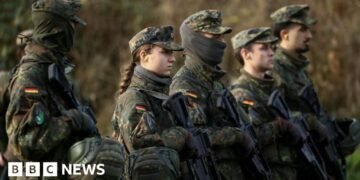
Germany abolished compulsory military service in 2011 but is now considering a shift back to voluntary military service amid rising security threats. Under proposed legislation, 18-year-old men would be required to fill out a questionnaire on their willingness to join the military and undergo medical evaluations to determine their eligibility. Chancellor Friedrich Merz has articulated ambitions to build the "strongest conventional army in Europe," targeting a military force size of 260,000 active personnel by 2035.
The plan has drawn protests, including school strikes in December, where students voiced concerns about being conscripted. Public opinion polls indicate mixed support, particularly among younger demographics.
France’s New Approach
France, which has not mandated military conscription for 25 years, is looking to expand its military personnel through a new volunteer program. This initiative will offer 10-month paid military training for young men and women, starting with an initial cohort of 3,000 and potentially increasing to 50,000 by 2035. President Emmanuel Macron emphasized the importance of preparation, underscoring a national prerogative to enhance defense readiness. Public surveys indicate broad support for voluntary service, although younger age groups show less enthusiasm.
Context & Previous Events
The presence of large conscript armies was a defining characteristic of NATO countries during the Cold War, but participation diminished following the collapse of the Soviet Union. Recent geopolitical tensions, particularly following Russia’s full-scale invasion of Ukraine in 2022, have reignited discussions around military preparedness and recruitment strategies among European NATO members.