






















U.S. Intensifies Pressure on Venezuela Amid Drug Trafficking Concerns
The United States has escalated its military presence in the Caribbean as President Donald Trump increases pressure on Venezuelan leader Nicolás Maduro, raising concerns over drug trafficking and the ongoing immigration crisis. This move follows the U.S. administration’s recent actions, including doubling the reward for information leading to Maduro’s capture and conducting military operations against alleged drug traffickers.
Why It Matters
The current situation in Venezuela is critical not only for regional stability but also for the U.S., which grapples with rising numbers of Venezuelan migrants and an influx of drugs, particularly fentanyl and cocaine. The measures taken by the Trump administration reflect a broader strategy to address these pressing issues through military means, prompting discussions about the legality and effectiveness of such actions.
Key Developments
- Increased Military Deployment: The U.S. has sent 15,000 troops and various naval vessels, including aircraft carriers and destroyers, to the Caribbean.
- Drug Trafficking Operations: More than 20 military strikes on boats allegedly involved in drug trafficking have been conducted, resulting in over 80 casualties.
- Ultimatum to Maduro: Trump reportedly issued a one-week ultimatum to Maduro to exit Venezuela, which was not accepted, leading to the closure of Venezuelan airspace.
- Accusations Against Maduro: Trump has accused Maduro of facilitating drug trafficking and "emptying" prisons to contribute to migration issues.
- Legal Concerns: Legal experts have raised doubts about the U.S. military’s current operations, suggesting they may not align with international law.
Full Report
Military Actions and Operations
The U.S. Navy has launched the largest military operation in the Caribbean since the 1989 invasion of Panama, aimed at curbing the flow of illicit drugs into the country. The Trump administration maintains that this campaign constitutes a necessary response to a non-international armed conflict with drug traffickers, labeling them as "narco terrorists." Nevertheless, experts have criticized the legal justifications for these strikes, arguing that the designated term does not incline them to lawful military action.
Reports indicate that the military operations have targeted vessels allegedly transporting drugs, leading to significant casualties. The U.S. government’s assertions that these actions protect American lives from drug-related harm have prompted debate about their legality and implications.
Maduro’s Position
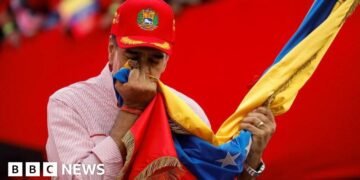
Nicolás Maduro, a former bus driver and union leader, has maintained control over Venezuela since succeeding Hugo Chávez in 2013. Under his regime, political repression and economic instability have spurred a mass exodus of Venezuelans—an estimated eight million—most of whom have sought refuge in neighboring countries, with hundreds of thousands reaching the U.S. Despite a 2024 election declared illegitimate by various countries, Maduro has retained power, further complicating the political climate.
In the context of these developments, Trump has publicly accused Maduro of enabling drug trafficking and facilitating mass migration. However, analysts suggest that Venezuela is primarily a transit point for drugs produced in Colombia and elsewhere, with the vast majority of cocaine trafficked into the U.S. following alternative routes.
Immigration and Drug Crisis Context
Trump has linked the surge of Venezuelan migrants to Maduro’s policies, aiming to stem immigration as a key focus of his administration. His administration’s emphasis on drug trafficking also aligns with an overarching goal to combat the opioid crisis plaguing American communities.
Context & Previous Events
Since Maduro’s rise to presidency in 2013, his administration has been marked by allegations of corruption and electoral manipulation. The U.S. was among several nations that rejected the legitimacy of the 2024 presidential election, recognizing opposition leader Edmundo González as "president-elect." Amid claims of drug trafficking ties to military and government officials within Venezuela, the U.S. has intensified its counternarcotics efforts, framing them as critical to national security.
This backdrop of a humanitarian crisis alongside political turmoil lays the groundwork for the current international and military tensions surrounding Venezuela.