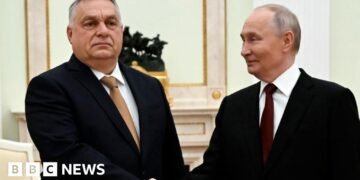























Orban Meets Putin Amid Calls for Peace Talks on Ukraine
Hungarian Prime Minister Viktor Orban met with President Vladimir Putin in Moscow just days before Russia is set to engage in discussions aimed at addressing U.S. proposals for resolving the ongoing war in Ukraine. This meeting underscores Orban’s role as one of Putin’s closest allies in Europe, a position that has continually strained Hungary’s relations with NATO and EU partners.
Why It Matters
This meeting highlights Hungary’s contentious position within the EU amidst pressing geopolitical tensions. With Hungary reliant on Russian energy supplies and EU pressures to sever these ties, Orban’s maneuvers may have significant implications for both regional stability and the upcoming parliamentary elections in Hungary.
Key Developments
- Orban reiterated his support for a peace summit in Budapest, previously proposed but postponed due to Russia’s uncompromising stance.
- During the meeting, Putin expressed gratitude for Orban’s suggestion of Budapest as a potential venue for U.S.-Russia talks, recalling discussions with former President Donald Trump.
- Orban’s government is preparing for parliamentary elections in April and may use any diplomatic success to bolster election prospects.
- Amid ongoing negotiations, Hungary is seeking to increase energy diversity while maintaining a significant reliance on Russian imports.
- Orban has openly challenged EU strategies to cut Russian oil and gas imports, claiming such steps would lead to economic hardships for Hungary.
Full Report
Diplomatic Engagements
Orban’s recent visit marks the second phase of his efforts to secure Russian energy supplies for Hungary and neighboring countries this winter. In addition to reinforcing ties with Russia, Orban has secured exemptions from U.S. sanctions on Russian fuel, contingent on his continued leadership.
Statements and Reactions
During their meeting, Putin acknowledged Orban’s “balanced” perspective on the Ukraine conflict, which has drawn ire from other EU leaders. But Orban has maintained that he stands for peace, criticizing what he calls the EU’s “war-mongering” approach.
Joining them in the Kremlin were key Russian officials, including Yuri Ushakov, who plays a role in negotiations with the U.S. Earlier this week, Orban reached out to European Commission President Ursula von der Leyen, urging immediate peace negotiations between the EU and the Kremlin.
Energy Strategy
Amid European Union pressures to eliminate all Russian energy imports by 2027, Orban has been vocal about the potential economic crisis such a move could trigger. Currently, Hungary relies heavily on Russian supply for its energy needs, receiving over 80% of its oil and gas and 100% of its nuclear fuel from Russia. He argues that without a balanced energy strategy that includes Russian deals, heating costs could soar.
Context & Previous Events
Since Russia’s full-scale invasion of Ukraine in 2022, Orban has asserted his position as a proponent of peace. He has backed Trump’s 28-point peace plan while simultaneously challenging EU policies that affect Hungary’s energy dependence on Russia. Recent polling indicates that Orban’s Fidesz party faces possible electoral defeat in April for the first time in 15 years, thereby adding political stakes to this diplomatic engagement.