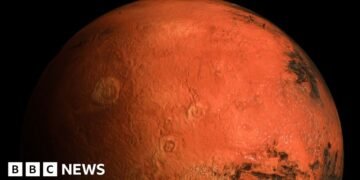























Scientists Record Evidence of Martian Lightning for the First Time
For the first time, researchers believe they have detected electrical activity in the Martian atmosphere, indicating that the planet may be capable of lightning. This discovery, recorded by NASA’s Perseverance rover, could alter our understanding of Mars’ atmospheric conditions and its potential to support life.
Why It Matters
The implications of this finding are significant, as it suggests that Mars—a planet long considered lifeless—might possess more complex atmospheric behaviors similar to those found on Earth. The presence of electrical discharges could inform future explorations aimed at understanding the planet’s habitability and atmospheric chemistry.
Key Developments
- Perseverance rover recorded what scientists are calling “mini lightning” through its SuperCam instrument.
- A team of French researchers analyzed 28 hours of audio data spanning two Martian years.
- Electrical discharges were typically linked to dust devils and storm fronts on Mars.
- Scientists are considering sending more advanced instruments to Mars for further verification of these findings.
- The discovery adds Mars to the list of planets known to exhibit atmospheric electrical activity, alongside Earth, Saturn, and Jupiter.
- Recent discoveries of minerals with unusual markings on Martian rocks may also hint at past life on the planet.
Full Report
Discovery of Electrical Activity
Scientists have recorded electrical discharges in Mars’ atmosphere, marking a significant milestone in planetary exploration. The Perseverance rover, operational since 2021, collected audio and electromagnetic data that led to this groundbreaking finding. These discharges, referred to as “mini lightning,” provide crucial insight into Martian weather systems.
Research Methodology
A team from the Institute for Research in Astrophysics and Planetology in France examined nearly 28 hours of audio recordings made by the rover. The analysis took place over what equates to two Martian years, or 1,374 Earth days. The researchers found a correlation between the electrical discharges and phenomena such as dust devils, which are small whirlwinds formed by rising hot air. These internal movements can generate electrical pulses.
Scientific Reactions
Dr. Baptiste Chide, the lead author of the study, emphasized the importance of these findings. He noted that the electrical discharges could drastically impact our understanding of Martian atmospheric chemistry, climate, and potential habitability. However, Dr. Daniel Pritchard, a particle physicist, cautioned that while the recordings offer compelling evidence, their nature—audible rather than visually confirmed—means some skepticism is likely to persist in the scientific community.
Examining Signs of Life
Coinciding with this discovery, scientists recently identified Martian rocks marked with unusual patterns dubbed “leopard spots” and “poppy seeds.” These features contain minerals that may have been formed by ancient microbes. NASA suggests that these geological characteristics could represent the clearest indicators of past life on Mars, adding another layer of intrigue to ongoing research.
Context & Previous Events
Historically, Mars has been viewed as a cold and desolate desert. However, evidence indicates that the planet once had a thick atmosphere and bodies of water, making it an appealing location to search for signs of early life. The Perseverance rover was specifically dispatched to the Jezero Crater region due to its geological features that suggest it may have once been suitable for life.