






















Northeast Syria in Turmoil as Kurdish Authorities Face Growing Threats
Northeast Syria is experiencing a significant shift in power dynamics, raising alarms about the future of the region’s Kurdish population. Once governed with a high degree of autonomy, Kurdish authorities now warn that their political existence hangs in the balance as government forces ramp up their offensive efforts.
Why It Matters
The ongoing clashes between Kurdish fighters and Syrian government troops are destabilizing an already fragile quest for lasting peace in Syria. As these conflicts threaten to erase the Kurdish-led semi-autonomous governance, there are growing fears about the return of past hostilities, which could reignite violence in a country still reeling from years of civil war.
Key Developments
- Kurdish authorities warn of serious threats to their political future amid government advances in northeast Syria.
- Iran-backed forces loyal to President Ahmad al Sharaa have moved deep into Kurdish-held territories, challenging the region’s control.
- The Kurdish-led Syrian Democratic Forces (SDF) prepared to defend their communities, expressing feelings of betrayal from the U.S. for shifting support towards the Syrian interim government.
- Significant cities, including Raqqa, have been recaptured by government forces, triggering chaos among displaced populations.
- The al Hawl detention camp, holding families linked to the Islamic State, has also been affected by recent military maneuvers, leading to increased tensions and fears of resurgence for extremist factions.
- Reports of violence against Kurdish communities have intensified, with many civilians fleeing advancing government troops.
Full Report
Growing Tensions in Hasakah
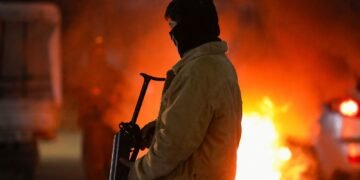
In the city of Hasakah, Kurdish fighters are bracing for conflict, stressing their commitment to protect their land. Local sentiment is largely one of betrayal, as many residents accuse the United States of realigning its support to favor the regime in Damascus. This has coincided with aggressive territorial advances by forces loyal to interim President Ahmad al Sharaa, escalating fears among Kurdish leaders of a campaign to recapture the region.
Chaos in Raqqa and Beyond
In the aftermath of government forces’ reclaiming of Raqqa, formerly a center of ISIS activity, Kurdish fighters have been forced to retreat, stoking unrest among the populace. The precarious conditions have been exacerbated at al Hawl camp, where prior military actions have led to overcrowding and disarray. Residents, like 20-year-old Zeelan, have expressed hopelessness over their stagnant existence, having lived in these dire conditions for nearly a decade.
The Shift in Al Roj Camp
Camps holding relatives of ISIS affiliates, such as the al Roj camp, reflect changing dynamics post-Damascus’s renewed sovereignty. As fear and uncertainty envelop residents, camp director Hikmya Ibrahim noted a heightened sense of empowerment among women, reflecting a perception that extremist ideologies could resurgence amid the new government’s advances.
Impact on Civilians
Displacement has surged as families attempt to escape from ongoing hostilities. In Qamishli, Shireen Abdul Fattah and her family have taken refuge in a mosque, living under constant threat of violence and airstrikes. Her assertion that the new leadership harbors hostility towards Kurdish communities echoes a widespread sentiment among the region’s residents.
Context & Previous Events
For over a decade, Kurdish authorities governed northeast Syria largely independently, primarily governed through the Syrian Democratic Forces (SDF), which played a crucial role in combating the Islamic State. However, the political landscape began altering earlier this year with intensified offensives from Syrian government forces, raising questions about the future of Kurdish autonomy and regional stability.