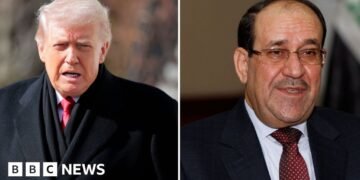























Trump Threatens to Cut US Support for Iraq if Maliki Returns to Power
President Donald Trump has warned that the United States may halt its support for Iraq should former Prime Minister Nouri al-Maliki regain leadership. Al-Maliki was recently nominated by a coalition of Shia parties, stirring concerns in Washington over his ties to Iran and the potential ramifications for US interests in the region.
Why It Matters
The situation highlights the complex dynamics of US-Iraqi relations, particularly regarding Iran’s influence in Iraq. Trump’s stern warning suggests significant stakes for both countries, emphasizing the precariousness of Iraq’s political landscape and its dependence on US support for stability. The outcome of Maliki’s potential return is likely to affect regional security and influence US foreign policy.
Key Developments
- Trump criticized Maliki on Truth Social as a "very bad choice," referencing his prior tenure from 2006 to 2014, which saw increased poverty and chaos in the country.
- Following his endorsement by the Shia coalition known as the Coordination Framework, Maliki is anticipated to be nominated by Iraq’s ceremonial president.
- Iraq’s parliamentary vote to elect a new president was postponed due to disagreements over candidates.
- Trump’s comments included a stark warning that Iraq would have "zero" success without US backing if Maliki assumes office.
- Secretary of State Marco Rubio echoed these concerns in a call with current Prime Minister Mohammed Shia al-Sudani, noting that an Iranian-controlled government would not prioritize Iraq’s interests.
Full Report
Background on Maliki’s Leadership
Nouri al-Maliki served as Iraq’s Prime Minister from 2006 until 2014, during which his administration was characterized by severe sectarian violence and unrest. His term ended amid the rise of the Islamic State group, which capitalized on discontent among various factions, particularly among Sunni communities. Maliki’s governance style, marked by a heavy-handed approach to dissent, has been criticized for contributing to the radicalization of extremist groups.
Current Political Dynamics
The nomination of Maliki as a prime ministerial candidate has reignited tension in Baghdad, with the political landscape deeply influenced by Iranian-backed parties. The U.S. has expressed ongoing concern about Iranian influence in Iraq, particularly regarding groups associated with Iran’s Islamic Republic.
Underlining the political stakes, Trump’s intervention reflects a shift from traditional diplomatic practices; he has historically involved himself in foreign elections, favoring right-wing candidates in various countries. This includes recent actions in countries like Poland and Romania, as well as transitioning new leadership in Honduras.
Context & Previous Events
Nouri al-Maliki rose to prominence following the U.S.-led invasion of Iraq in 2003, which culminated in the removal and execution of Saddam Hussein. This conflict was especially significant for Iraq’s Shia majority, who had faced oppression during Hussein’s regime. The period of Maliki’s rule was marked by escalating violence, particularly between Kurdish and Sunni factions, leading to widespread instability and paving the way for the rise of the Islamic State by 2014.