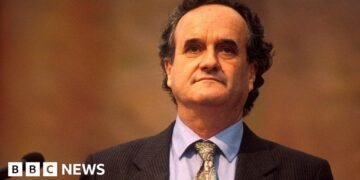























BBC’s "Voice of India," Sir Mark Tully, Passes Away at 90
Sir Mark Tully, a renowned broadcaster and journalist celebrated as the BBC’s "voice of India," has died at the age of 90. Tully’s storied career spanned decades, during which he covered pivotal moments in Indian history, marking him as a significant figure in international journalism.
Why It Matters
Tully’s work was instrumental in bringing Indian culture and issues to a global audience. His journalistic integrity and commitment to secularism contributed significantly to the understanding of India’s complex societal landscape. His passing marks the end of an era for many who regarded him as a trusted voice reporting from the heart of India.
Key Developments
- Sir Mark Tully passed away at the age of 90.
- He was known for reporting on critical events, including wars, riots, and the Bhopal gas tragedy.
- Tully faced personal danger while covering the demolition of the Babri mosque in Ayodhya in 1992.
- He was born in Calcutta in 1935 and spent most of his life in India, developing strong ties with the local community.
- Tully returned to India in 1965, working initially as an administrative assistant for the BBC before transitioning to a reporting role.
- Honored with multiple accolades, including two Padma awards from India and a knighthood from the UK.
Full Report
A Career Defined by Insight and Compassion
For decades, Mark Tully’s voice resonated with BBC audiences worldwide. His rich and warm tones became synonymous with insightful reporting on India, where he covered both the struggles and triumphs of its people. From war and famine to political upheavals, Tully approached his work with a blend of journalistic rigor and genuine affection for the country he called home.
In 1992, during a highly tense moment in Ayodhya, Tully faced threats from a crowd of Hindu activists who opposed BBC coverage. He was locked in a room for his safety until local officials intervened. Reflecting on the event years later, he called the destruction of the Babri mosque a grave setback for Indian secularism.
A Deep-rooted Connection to India
Born in what was then Calcutta, Tully’s upbringing was steeped in the traditions of the British Raj, yet he forged a deep connection to India. Fluent in Hindi, he garnered respect from many Indians who affectionately addressed him as "Tully sahib." His friendships with prominent political figures and social activists highlighted his cross-cultural rapport.
Tully joined the BBC in 1965 and quickly became more than just a foreign correspondent. He traveled extensively, illustrating the lives of everyday Indians alongside the elite. His style, marked by a unique blend of personal insight and factual reporting, resonated with many, and his commitment to secularism remained steadfast throughout his career.
Departure from the BBC and Continued Influence
Tully faced expulsion from India during a state of emergency declared by then-Prime Minister Indira Gandhi in 1975. Nevertheless, he returned 18 months later and became the BBC’s head of bureau in Delhi, where he played a key role in covering stories throughout South Asia.
In 1993, Tully publicly criticized the BBC leadership, claiming the organization operated out of fear, leading to his resignation the following year. However, he continued to contribute to BBC programming, particularly through Radio 4’s "Something Understood," focusing on faith and spirituality.
Lasting Recognition
Despite being a foreign journalist, Tully received two of India’s highest honors, the Padma Shri and Padma Bhushan. In the UK, he was knighted in 2002, an award he saw as a recognition of India’s culture. Tully remained in Delhi after leaving the BBC, continuing to write and engage with Indian society while also holding British nationality and later becoming an Overseas Citizen of India.
Context & Previous Events
Mark Tully was born in 1935 during British rule in India and belonged to a family with deep-rooted ties to the region. His education in Britain led him back to India as a journalist, where he would spend the majority of his life. Tully’s coverage of significant historical events, including the birth of Bangladesh and the military rule in Pakistan, places him among the noteworthy journalists of his time.