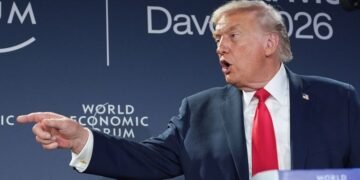























Former President Donald Trump has issued a stark warning, threatening to impose a 100% tariff on Canadian goods in response to Canada’s recent trade agreement with China. This announcement highlights increasing tensions as the Trump administration perceives potential threats to economic interests in the U.S.
The proposed tariff has significant implications for U.S.-Canada trade relations, especially given the historical importance of these ties. It underscores the complexities of international trade agreements amid escalating geopolitical tensions, as both nations navigate their own economic priorities while balancing relations with global powers like China.
– Trump criticized Canadian Prime Minister Mark Carney for what he perceives as a misguided trade strategy that could turn Canada into a “Drop Off Port” for Chinese goods.
– The former president’s remarks came on his Truth social media platform, further emphasizing his disdain for the recent Canada-China trade deal, which includes lowered tariffs on Chinese electric vehicles.
– Trump reiterated his belief that if Canada continues on this path, it could face severe tariffs, effectively halting Canadian imports into the United States.
– The relationship between Trump and Carney appears strained, with Trump referring to him as “Governor Carney,” a nickname he previously used for Justin Trudeau.
The tension between the U.S. and Canada seems to be escalating, particularly as this conflict overlaps with broader international issues. Trump emphasized that Canada’s survival is inherently linked to the United States. In a related speech, Carney called for new alliances to address the aggressive behaviors of both American and Chinese administrations, advocating for a stance that resists autocratic influences.
Currently, Canada has been somewhat insulated from the tariffs imposed by the United States due to the Canada-US-Mexico Agreement, which is due for a review this year. However, Trump’s recent threats could complicate negotiations on this front, especially as no agreement to reduce existing tariffs has been reached with Carney.
Further complicating relations, Trump revoked Carney’s invitation to join his “Board of Peace,” initially proposed as part of efforts to address international conflicts, including the war in Gaza. This move further signals deepening discord between the two leaders.
In recent remarks, Trump made headlines with an altered map depicting the United States as encompassing territories such as Canada, Venezuela, Greenland, and Cuba, inferring an expansionist mindset. During these developments, the ongoing conflict regarding NATO commitments and the management of international relations has added layers to the discussions between the U.S. and its neighbors.