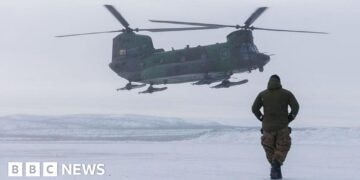























Canada’s Arctic: A Geopolitical Frontier in Need of Defense Reinforcement
As geopolitical tensions rise in the Arctic region, Canada finds itself at a strategic crossroads. With significant investments planned for Arctic security, the Canadian government seeks to bolster its defenses amid escalating competition from nations such as Russia, the United States, and China.
Why It Matters
The Arctic is increasingly viewed as a critical area of interest due to its vast resources and strategic waterways. With Canada’s unique geographical position, the nation must navigate complex relationships with its powerful neighbors while ensuring the safety and sovereignty of its territory.
Key Developments
- Increased Defense Investment: Prime Minister Mark Carney announced unprecedented funding for radar systems, submarines, and aircraft to enhance Canada’s northern defenses.
- Heightened U.S. Attention: The Trump administration expressed concerns about Arctic vulnerabilities, leading to an executive order aimed at maintaining American supremacy in the region.
- Hypersonic Threats: Experts warn that existing defense frameworks may be ill-equipped to handle advanced missile technology, necessitating urgent upgrades.
- Tense Diplomatic Relationships: Statements from Trump indicating Canada’s need to join defense initiatives have raised eyebrows and tensions between the two nations.
Full Report
Defense Strategies
The Arctic encompasses nearly 4 million square kilometers, yet its population is akin to smaller towns like Blackburn, England. Despite its vastness, Canada’s military presence consists of aging early-warning radars, eight bases, and around 100 Coast Guard personnel tasked with monitoring a coastline that spans 162,000 kilometers. According to Pierre Leblanc, a former commander of the Canadian Forces Northern Area, the harsh environment poses significant challenges for defense.
Rising Geopolitical Competition
The Arctic region is increasingly becoming a battleground for geopolitical interests, especially with Russia and the U.S. flanking either side of the North Pole. China has also declared itself a "near Arctic state," escalating its naval presence in the area. The growing interests and military capabilities of these nations prompt Canada to reassess its strategic posture.
Domestic Responses
In April, the Trump administration emphasized its commitment to freedom of navigation in Arctic waters, which has galvanized Canadian efforts to fortify its defenses. Prime Minister Carney highlighted ongoing investments in various military assets designed to enhance operational capabilities in the Arctic.
Challenges Remain
Despite increased funding and focus, significant challenges persist. Experts like Troy Bouffard from the Center for Arctic Security and Resilience caution that current defenses, primarily established during the Cold War, may not effectively counteract modern threats such as hypersonic missiles. Traditional ground-based systems may prove inadequate against these speedier projectiles, necessitating improvements in radar technology and satellite coverage.
Context & Previous Events
The spotlight on Arctic security was intensified nearly four years ago following Russia’s invasion of Ukraine, which prompted concerns about regional vulnerabilities. Additionally, recent proposals from the Trump administration regarding Greenland have complicated the diplomatic landscape, with Canadian officials seeking to assert their autonomy while addressing U.S. security concerns. Conversations around Arctic defense strategies continue, impacted by both political rhetoric and shared operational practices between Canada and the U.S.






