






















Investigation Reveals Key Factors in Fatal Spanish Train Derailment
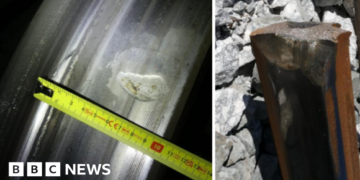
A recent investigation into last Sunday’s tragic train derailment in Spain, which resulted in 45 fatalities, has identified a critical fracture in the track that predated the accident. This development sheds light on the immediate causes of the disaster and the implications for rail safety in the region.
Why It Matters
This incident is Spain’s deadliest rail disaster in over a decade, calling into question the safety protocols employed by both public and private rail operators. The preliminary findings from the CIAF rail investigation commission may lead to significant changes in the country’s rail infrastructure and regulatory oversight, as well as a renewed focus on the maintenance of high-speed rail systems.
Key Developments
- A fracture in the track occurred shortly before a high-speed Iryo train derailed.
- The rear carriages of the derailed train crossed onto an adjacent track, colliding with an oncoming Renfe train.
- A gap of nearly 40cm (15 inches) in the track is under scrutiny as a possible cause of the derailment.
- Grooves were discovered on the wheels of the Iryo train’s carriages, consistent with prior trains that traveled over the same section of track.
- The CIAF referred to its findings as a “working hypothesis” that requires further investigation.
- Transport Minister Óscar Puente emphasized that if the track fracture was the cause, it happened close to the time of the accident and may have been undetectable.
Full Report
Investigation Findings
The CIAF investigation has revealed that the Iryo train, which was on its journey from Málaga to Madrid, derailed around 19:45 local time. The rear carriages of the train collided with a Renfe train headed for Huelva. The report indicated that “carriage six” of the Iryo train lost connectivity due to a complete lack of continuity in the track’s structure.
Condition of Train and Track
Transport Minister Puente confirmed that notches were found on the wheels of the Iryo train’s carriages, a detail that aligns with the condition of three earlier trains that also traversed the problematic track without incident. The CIAF noted that similar notches existed on carriages two, three, and four of the Iryo train, while carriage five displayed signs that it may have encountered issues before derailing.
Future Steps
The CIAF has stated that its preliminary report serves as a basis for further investigation and detailed analysis, stressing that definitive conclusions require comprehensive technical evaluations. The minister’s statements suggest that enhancing safety measures in rail operations may become a priority following this incident.
Context & Previous Events
The Adamuz derailment is identified as Spain’s worst rail disaster since the Galicia train crash in 2013, which resulted in 80 fatalities and over 140 injuries. This context underscores the gravity of the situation and the urgent need for improved safety standards in the nation’s rail system.