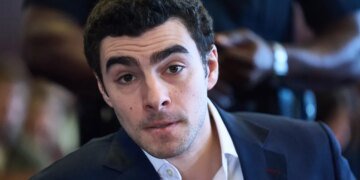























Court Hearing to Decide Fate of Evidence in High-Profile Murder Case
A police officer from Altoona, Pennsylvania, is set to testify in court today regarding the department’s procedures for managing personal belongings of arrested individuals. This hearing comes as accused assassin Luigi Mangione seeks to exclude evidence from the federal case against him, which includes writings critical of the insurance industry and the weapon allegedly used in the murder of UnitedHealthcare CEO Brian Thompson.
Why It Matters
This legal battle underscores significant questions about law enforcement protocols and the constitutional rights of suspects. The outcome could have implications not only for Mangione but also for the broader legal landscape concerning the preservation and handling of evidence in criminal cases.
Key Developments
- Mangione was arrested five days after the shooting of Brian Thompson, during which police discovered evidence, including the suspected murder weapon, in his backpack.
- The shooting incident occurred in front of a surveillance camera, prompting law enforcement to release images of Mangione in a nationwide effort to locate him.
- The defense argues that the search of Mangione’s belongings was conducted without a warrant, challenging the admissibility of the evidence.
- A Pennsylvania state judge has yet to issue a ruling regarding similar concerns raised in a state court, where multiple witnesses have provided testimony.
- Prosecutors contend that the evidence would have inevitably been discovered, thus maintaining the legality of the search.
- Additionally, the defense is working to have the principal federal charges against Mangione dismissed, potentially shielding him from a death penalty sentence if convicted.
Full Report
Evidence Suppression Hearing
During the hearing, a police officer from Altoona will clarify departmental protocols regarding the handling of property taken from arrested individuals. Testimonies from various officers and witnesses, including a McDonald’s manager where Mangione was spotted days after the incident, have already been submitted to the court.
Judge Margaret M. Garnett has ordered the officer’s attendance, emphasizing that any officer present does not necessarily need to be involved in the arrest. Meanwhile, the government has been directed to provide an affidavit in support of the federal search warrant, relating to the items found in Mangione’s possession.
Charges Against Mangione
Prosecutors have argued that Mangione’s actions fit within the framework of a federal "crime of violence," which is a crucial component of qualifying the murder charge for federal jurisdiction. They claim that the stalking of Thompson across state lines prior to the murder establishes this necessary connection.
Thompson, who was shot and killed on December 4, 2024, while attending a business conference in New York City, was the father of two and heavily involved in the corporate world. He had traveled from Minnesota to attend the event when the tragic shooting occurred.
Legal Implications and Defense Strategy
The defense’s position hinges on a recent Ninth Circuit ruling in United States v. Gomez, which questioned whether certain assault charges met the threshold for a "crime of violence." This could significantly impact the prosecution’s ability to pursue the death penalty against Mangione.
“It’s like a series of dominos,” remarked Joshua Ritter, a criminal defense attorney. “The only way that the federal government can get to a death penalty charge is through proving that the murder involved a violent felony.”
Context & Previous Events
On December 4, 2024, UnitedHealthcare CEO Brian Thompson was killed in Midtown Manhattan as he prepared for a conference. Five days later, police arrested Luigi Mangione, who was later linked to the crime through surveillance and a search of his belongings. As the case moves forward, both the suppression hearing and the discussions surrounding the federal charges will be closely watched as they highlight the delicate balance between legal process and individual rights.






