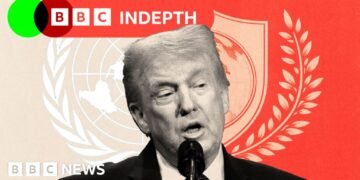























Trump Unveils Global Peace Board at Davos, Raising Eyebrows Worldwide
U.S. President Donald Trump made a controversial debut of his new Board of Peace at the Davos Economic Forum, presenting it as a means to end decades of conflict and suffering across the globe. While some leaders express cautious optimism, critics voice concerns over the board’s implications for the existing international order.
Why It Matters
The inauguration of the Board of Peace signifies Trump’s ambition to reshape the global diplomatic landscape. As the UN faces challenges in its role as a peacemaker, this initiative sparks questions about the future of multilateral institutions and the effectiveness of U.S. leadership on global conflicts.
Key Developments
- Trump inaugurated his Board of Peace during the Davos Economic Forum, claiming it could forge a lasting peace for the region and beyond.
- The Board will reportedly grant Trump vast powers, including authority over member states and the ability to appoint a successor.
- Nineteen countries, spanning various regions, attended the Board’s unveiling, with some expressing reluctance to join.
- Criticism arose regarding the Board’s potential disruption of existing international frameworks, particularly concerns from countries like Slovenia and the UK.
Full Report
Ambitious Vision
President Trump has laid out an ambitious vision during the official launch of his Board of Peace, asserting it can "end decades of suffering" and usher in a new era of global harmony. "Together we are in a position to forge a beautiful, everlasting peace," he declared, hoping to galvanize support amidst the world’s ongoing conflicts.
Trump’s vision, however, is met with skepticism from several global leaders. Polish Prime Minister Donald Tusk took to social media to express caution, underscoring a common apprehension among allies regarding Trump’s unilateral approach to international relations.
Structure and Power
Leaked drafts of the Board’s charter reveal that Trump would serve as its lifetime chairman, regardless of his status as president. The charter grants him extensive powers, including the ability to invite or reject member states, establish or disband subsidiary bodies, and appoint his replacement when necessary. Countries wishing to join the Board must contribute a substantial fee of $1 billion.
This structure raises questions among various nations. For instance, Sweden has publicly declined to join, and Norway seeks further dialogue about the proposal. Meanwhile, a coalition of seven predominantly Muslim countries, including six Arab nations, expressed their desire for a just peace in Gaza, although the current charter does not explicitly address the conflict.
Responses and Concerns
In reaction to the Board’s establishment, some leaders conveyed a mix of hope and caution. UK Foreign Secretary Yvette Cooper raised doubts about Russia’s involvement, while Slovenia’s Prime Minister Robert Golob articulated concerns regarding the Board’s interference with established international frameworks.
Trump’s remarks heightened these concerns. He asserted that once fully operational, the Board could act "in conjunction with the United Nations," but also hinted that it could potentially overtake existing institutions, stating, "the UN just hasn’t been very helpful."
The Road Ahead
While Trump positions himself as a peacemaker, historical context complicates his claim to broker resolutions. Past ceasefires and peace agreements under his administration often faced immediate collapse, illustrating the difficulties inherent in long-term diplomacy. The immediate test for the Board will be its handling of the volatile situation in Gaza, involving conflicting interests between Israeli and Palestinian leaders.
Context & Previous Events
The Board of Peace initiative stems from U.S.-led efforts to resolve violence in Gaza and received endorsement from a UN Security Council resolution. In taking on this endeavor, Trump steps into a role long held by the UN, which has struggled to maintain its authority as a peacemaker in recent years. The launch of this Board also comes amid heightened U.S. military actions in places like Venezuela and ongoing tensions with Iran, adding layers of complexity to an already fractious global landscape.