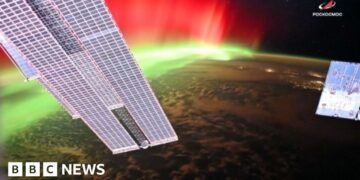























Auroras Dazzle Earth as Powerful Solar Storm Hits
Cosmonaut Sergey Kud-Sverchkov recently captured stunning images of auroral lights from the International Space Station (ISS), occurring amid one of the strongest solar storms in more than two decades. This rare cosmic event highlights the intricate relationship between solar activity and Earth’s atmosphere and showcases the dynamic beauty of our planet viewed from space.
Why It Matters
The sighting of auroras, particularly during significant solar storms, underscores the impact of solar activity on Earth’s environment. Such events not only produce breathtaking visuals but also serve as reminders of the Sun’s influence on our planet and the potential implications for satellite communications and power grids.
Key Developments
- Sergey Kud-Sverchkov recorded the auroras from the ISS during a significant solar radiation storm.
- The storm is regarded as one of the most impactful incidents in over 20 years, according to the National Weather Service’s Space Weather Prediction Center.
- The last comparable solar radiation storm occurred in October 2003.
- Auroras form when solar storms release high-speed charged particles that collide with the Earth’s atmosphere, creating vibrant light displays.
Full Report
During his time aboard the ISS, Kud-Sverchkov was fortunate to capture the breathtaking auroras that lit up the skies. These natural light displays were a result of intense solar activity, marking a period of heightened solar radiation. The National Weather Service’s Space Weather Prediction Center indicated that such powerful storms are rare, making this visual spectacle even more significant.
As solar particles collided with Earth’s atmosphere, they produced the stunning displays of light that can be seen in the polar regions, holding the attention of both scientists and the general public. These occurrences emphasize the connection between solar phenomena and atmospheric events, showcasing the delicate balance of forces that governs our planet’s environment.
Context & Previous Events
The last notable solar radiation storm of similar magnitude was documented in October 2003. Understanding the historical context of these solar events allows scientists and enthusiasts to appreciate their rarity and beauty, as well as to study the behavior of solar activity in relation to Earth.