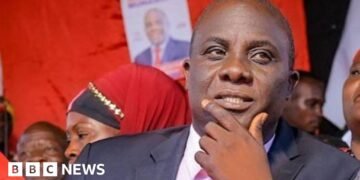























Opposition Lawmaker Detained Amid Uganda’s Election Violence Controversy
Ugandan police have detained Muwanga Kivumbi, a prominent lawmaker allied with opposition leader Bobi Wine, amid allegations of his involvement in election-related violence that erupted following last week’s elections. The situation underscores rising tensions in a nation already grappling with accusations of electoral fraud and unrest.
Why It Matters
The detention of Kivumbi marks a significant escalation in Uganda’s political climate, where the recent elections have been marred by violence and allegations of misconduct. With President Yoweri Museveni securing a seventh term, this incident reflects deeper issues of political stability and the ongoing struggles faced by opposition figures in a country historically characterized by a lack of peaceful power transitions.
Key Developments
- Detention of Kivumbi: Muwanga Kivumbi was arrested for allegedly orchestrating violent attacks on a police station and a vote-tallying center.
- Contradictory Death Toll: Official police reports claim seven fatalities, while Kivumbi asserts that ten people were killed at his residence.
- Government Reaction: The Uganda Police Force announced that Kivumbi would be presented in court soon, emphasizing the connection to political violence.
- Election Aftermath: Tensions escalated following Museveni’s re-election announcement, during which he warned opposition members of potential violence.
- Widespread Arrests: Authorities have detained dozens of individuals linked to election-related incidents across Kampala since the polls.
Full Report
Details of Arrest
Muwanga Kivumbi, who serves as the deputy leader of Bobi Wine’s National Unity Platform (NUP), has found himself at the center of allegations related to recent political violence. Police claim that Kivumbi coordinated attacks on both a police station and a vote-counting facility in response to their electoral loss, a charge the NUP vehemently denies. Reports indicate Kivumbi will face judicial proceedings in the near future as the police continue to investigate these incidents.
Diverse Accounts of Violence
The violence that unfolded after the elections has resulted in conflicting death tolls. The Uganda Police Force has reported seven fatalities linked to the unrest, whereas Kivumbi has claimed that ten individuals were killed outside his home as they awaited election results. The discrepancies in these accounts highlight the ongoing chaos and lack of clarity surrounding the electoral process.
Museveni’s Victory Speech
Following his victory, President Museveni cautioned opposition leaders, including Kivumbi, against planned attacks on polling places. He specifically referenced clashes in the Butambala district, where he stated that police were forced to respond with lethal measures against alleged opposition supporters wielding machetes.
Bobi Wine’s Claims
Bobi Wine, who has been critical of the electoral results—viewing them as fraudulent—has gone into hiding following a police raid on his home. Wine has denounced the electoral process as a "fake" exercise and alleged that a "silent massacre" is occurring, particularly targeting political activists. He recently claimed on social media that over 100 fatalities were linked to election violence, although he did not provide verifying evidence.
Army Chief’s Statements
Compounding the confusion, Uganda’s army chief, Gen. Muhoozi Kainerugaba—President Museveni’s son—asserted that the military had killed 22 opposition supporters during the unrest, adding yet another layer to the ongoing narrative of violence and political distrust.
Arrests in the Aftermath
In the wake of the elections, Ugandan authorities have reportedly detained numerous youths on various charges related to election disturbances. This crackdown suggests a broader strategy to stifle dissent and maintain order in the face of widespread allegations of electoral fraud.
Context & Previous Events
President Yoweri Museveni, who initially rose to power as a rebel leader in 1986, will have served 45 years in office by the end of his latest term in 2031. Uganda has not experienced a peaceful transition of presidential power since gaining independence, a reality that continues to fuel political unrest and opposition retaliation amid claims of electoral manipulation.