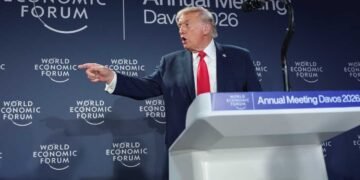























Tensions Rise as Trump Addresses Allies at World Economic Forum
President Trump softened his earlier aggressive stance regarding Greenland, claiming he would not resort to military action to claim the territory. However, during his speech at the World Economic Forum in Davos, Switzerland, Trump continued to make contentious remarks that could further alienate U.S. allies and disrupt long-standing international relationships.
Why It Matters
Trump’s rhetoric at the Forum underscores the shifting dynamics of global alliances. His continued calls for U.S. territory in Greenland not only strain ties with Denmark but also reflect a broader challenge to the international order that the United States has upheld since World War II. The implications of these remarks raise questions about future cooperation among allied nations, particularly as geopolitical tensions rise.
Key Developments
- Trump confirmed he does not intend to use force to acquire Greenland but indicated he still desires the territory.
- He mentioned on social media that there could be a potential deal regarding Greenland and the Arctic Region.
- Canadian Prime Minister Mark Carney warned that the global order established by the U.S. is unraveling, hinting at geopolitical shifts favoring countries like China.
- Italy’s Prime Minister Giorgia Meloni criticized Trump’s Greenland strategy, stating it would damage NATO relations.
Full Report
Trump’s Remarks at Davos
During his address, Trump asserted, "I don’t have to use force. I don’t want to use force. I won’t use force," in reference to Greenland. Yet, he voiced dissatisfaction with relationships with U.S. allies, calling into question the foundational agreements that have enabled decades of global cooperation.
Reactions from Allies
Trump’s remarks have sparked concern among U.S. allies, who have historically sought to avoid confrontation with his administration. The Canadian Prime Minister’s speech gained attention when he spoke of a "rupture in the world order," emphasizing that the geopolitical landscape is becoming increasingly unpredictable. He hinted that nations like China may now be perceived as more reliable partners than the U.S., especially following recent trade tensions.
Shifts in U.S. Foreign Policy
Trump’s approach marks a significant departure from traditional U.S. foreign policy, which has prioritized military alliances and free trade. His actions have included vocal opposition to NATO and the dismantling of established trade agreements, leading to a reevaluation of U.S. commitments abroad. Critics argue that his "America First" policy, while aiming to prioritize domestic interests, undermines international cooperation.
Misleading Statements
In his address, Trump made claims suggesting NATO has not benefited the U.S. historically, disregarding the alliance’s role in collective defense. NATO’s activation post-9/11 demonstrated a commitment of allied nations to support the U.S., a fact that contradicts Trump’s portrayal of their relationship. Additionally, while Trump frequently depicts European allies as inept, it is crucial to recognize that the U.S. maintains numerous military installations across Europe, complicating this narrative.
Context & Previous Events
Historically, U.S. presidents have embraced a diplomatic framework built on military alliances and economic partnerships since the end of World War II. Under Trump, however, this system has faced increasing strains as bilateral relationships shift in response to his administration’s policies. Recent disagreements over trade and military commitments reveal a growing division between the U.S. and its long-standing partners.
As the global landscape continues to evolve, Trump’s administration appears to be redefining America’s role on the world stage, prompting both national and international scrutiny.






