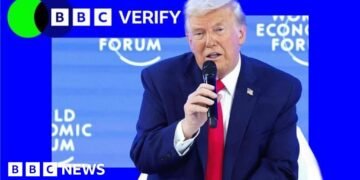























During his recent speech at the World Economic Forum in Davos, Switzerland, former President Donald Trump made several assertions that have been criticized for lacking factual accuracy. His statements spanned various topics, including U.S. foreign relations, NATO contributions, and renewable energy in China.
These claims have larger implications for international relations and the U.S. reputation on the global stage. As world leaders gathered in Davos to discuss critical issues, Trump’s remarks reflect ongoing tensions surrounding U.S. foreign policy and military alliances, raising questions about the integrity of U.S. commitments abroad.
Key Developments
- Trump inaccurately claimed that the U.S. “gave Greenland back” to Denmark after World War Two, despite it never being U.S. territory.
- He overstated U.S. financial contributions to NATO, claiming the U.S. pays “virtually 100%” of expenses, while it actually accounted for about 65% in recent years.
- His assertion that the U.S. received nothing from NATO overlooked the alliance’s collective defense model, which the U.S. has invoked in past conflicts.
- Trump mischaracterized China’s wind energy production, failing to acknowledge that China leads the world in wind-generated power.
- He claimed the UK takes 92% of North Sea oil revenue, although the actual figure is lower, accounting for corporate taxes and a supplemental windfall tax.
- Finally, Trump asserted there were $18 trillion in secured investments for the U.S., a claim lacking supporting evidence and contradicted by official figures.
Full Report
Greenland Claim
Trump reiterated his interest in purchasing Greenland from Denmark, remarking that the U.S. “gave Greenland back” in the aftermath of the Second World War. However, historical records show that in 1933, an international court recognized Greenland as Danish territory. A defense agreement was signed in 1941, allowing U.S. forces to protect the territory but did not involve any transfer of sovereignty.
NATO Contributions
The former president argued that the U.S. bears virtually all costs associated with NATO, a claim that has been fact-checked as inaccurate. U.S. defense spending represented approximately 65% of NATO’s total budget in recent years, with member nations committing to increase their spending to at least 2% of GDP by 2025—a figure Trump misrepresented by suggesting it was already at 5%.
NATO Engagement
In describing the U.S. relationship with NATO, Trump contended that the U.S. has “never gotten anything” from the alliance. This overlooks NATO’s core principle of collective defense and the significant contributions other member countries made, particularly following the 9/11 attacks when NATO allies supported U.S. military operations in Afghanistan.
China’s Wind Energy
The former president criticized wind energy and specifically mentioned China, claiming an inability to find any wind farms there. Contrary to this assertion, China hosts one of the world’s largest wind farms and is the leading nation in wind energy generation, producing more than twice the amount of the U.S. in 2024.
UK Oil Revenue
Trump’s comments about the UK’s oil revenue mistakenly asserted that the UK takes 92% of revenues from North Sea operations. The actual taxation model involves a corporation tax of 30% on profits, supplemented by an additional windfall tax, culminating in a total tax rate of around 78% on profits, not revenues.
Investment Claims
Additionally, Trump asserted that his administration had secured $18 trillion in investments for the country, a claim that lacks verifiable evidence. Current records, including a tracker from the White House, indicate total investments amount to around $9.6 trillion, significantly lower than Trump’s statement. Skepticism remains about the long-term viability of the investments touted during his presidency.
Context & Previous Events
Trump’s remarks come amidst ongoing debates about U.S. foreign policy and its commitments to international alliances. His previous comments regarding Greenland, NATO, and foreign investments have frequently drawn scrutiny for exaggeration or misinterpretation, raising questions about the accuracy of information shared at high-stakes international forums.