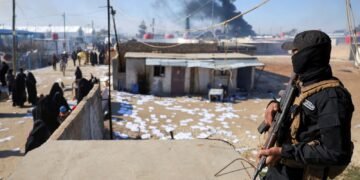























US Troops Transfer Islamic State Prisoners to Iraq Amid Rising Tensions in Syria
The United States military has commenced the transfer of Islamic State (IS) prisoners from Syria to Iraq, with the initial move involving 150 detainees. This transfer occurs against a backdrop of shifting power dynamics in Syria as the new government seeks to reestablish its authority, leading to clashes with the Syrian Democratic Forces (SDF).
Why It Matters
This prisoner transfer is significant as it highlights the ongoing struggle for control in Syria and the changing role of the SDF, which has been instrumental in the fight against IS. As the situation evolves, the safety and security of thousands of detained IS members hang in the balance, raising concerns over potential IS resurgence and stability in the region.
Key Developments
- 150 IS detainees were transferred from a facility in Hasakah, Syria, to a secure location in Iraq.
- U.S. officials indicated that up to 7,000 detainees might eventually be moved across the border.
- Roughly 200 low-level IS fighters escaped from Shaddadi prison following the withdrawal of SDF troops, though many were later recaptured.
- The Syrian government announced a ceasefire with the SDF after significant territorial gains.
- U.S. Central Command has been coordinating with both the Iraqi government and Syrian authorities regarding the situation.
Full Report
Prisoner Movement Initiated
U.S. military forces have successfully relocated 150 Islamic State prisoners from a detention center in Hasakah, Syria, to an undisclosed secure location in Iraq. This operation aligns with a broader plan that could culminate in the transportation of up to 7,000 IS detainees to facilities under Iraqi control. The U.S. military confirmed this move in a statement, emphasizing collaboration with the Iraqi government to enhance regional security and counter IS threats.
Clashes and Security Concerns
The latest developments follow a period of escalating tensions between the new Syrian government, led by President Ahmed al Sharaa, and the Kurdish-led SDF. With the SDF’s withdrawal from certain areas, there are growing concerns regarding the security of numerous prisons and detention camps they previously guarded. American officials reported that approximately 200 low-level IS fighters managed to escape from Shaddadi prison during the turmoil, although many have since been apprehended by government forces.
Syrian Government and SDF Interactions
In a notable shift, the Syrian government has achieved significant territorial advances against the SDF, prompting the declaration of a ceasefire. The interim agreement gives the SDF four days to contemplate integration into the Syrian state, a move that the U.S. has encouraged. U.S. officials, including Admiral Brad Cooper, who leads U.S. forces in the Middle East, have emphasized the importance of coordination between the Syrian regime and regional partners to avoid conflicts that could undermine security efforts.
Context of the Current Situation
Over 10,000 IS members are currently detained in Syrian prisons, alongside thousands of other individuals connected to the group. The SDF, which has received U.S. support to combat IS, appears to be losing its influence with the rise of the new Syrian government, established following the ousting of Bashar al Assad’s regime 13 months ago. U.S. envoy to Syria Tom Barrack stated that the SDF’s operational significance has diminished, as the Syrian government is now prepared to assume security responsibilities.