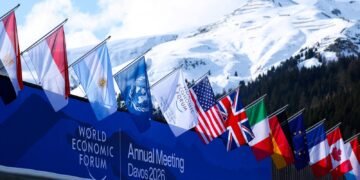























World Leaders Warn of Erosion of International Law at Davos
At the World Economic Forum in Davos, Switzerland, global leaders expressed grave concerns over a deteriorating international order, highlighting the resurgence of imperial ambitions and the decline of rules-based governance. Tensions surrounding U.S. President Donald Trump’s controversial remarks about Greenland and his aggressive trade policies dominated discussions.
Why It Matters
The current geopolitical climate is increasingly characterized by great-power rivalry, as leaders warn that traditional diplomatic norms may be eroding. With discussions over trade agreements and territorial claims, the implications for global stability and cooperation are significant. This shift may affect not just diplomacy but also economic relations and the overall balance of power among nations.
Key Developments
- World leaders at Davos described a “rupture” in the international order, suggesting a move towards a new era devoid of established rules.
- Canadian Prime Minister Mark Carney stated that nations must unite or risk becoming collateral damage in power struggles.
- French President Emmanuel Macron criticized U.S. trade policies, claiming they undermine European interests.
- European Commission President Ursula von der Leyen called for the establishment of a “new independent Europe” in response to current diplomatic challenges.
Full Report
Leaders’ Concerns at Davos
During the sessions at Davos, the underlying sentiment among world leaders was the urgent need to address a perceived erosion of international order. Many representatives outlined how international law appears to be disregarded, alluding to the “imperial ambitions” rekindled in the global sphere.
Trump’s Announcements
President Trump’s commentary on Greenland—claiming it as “part of North America” and suggesting potential annexation—was a key focus of criticism. His approach, combined with threats to impose tariffs, has led to significant unease, particularly in Europe and Latin America, where leaders express concern over U.S. intentions, especially regarding Venezuela’s oil.
Responses from Global Leaders
Canadian Prime Minister Mark Carney highlighted the necessity for middle powers to collaborate against the prevailing trend of great-power rivalry. He noted that economic integration is increasingly used as a tool for coercion, emphasizing the need for collective action among nations to safeguard their interests.
Macron echoed similar concerns, arguing against U.S. trade practices that he believes serve to weaken European sovereignty. He characterized the current geopolitical landscape as one where the strongest prevail, leading to a potential decline in cooperation and dialogue.
Meanwhile, von der Leyen stressed the importance of Europe taking decisive steps towards independence and unity in light of these challenges. She warned that a downward spiral in Western diplomatic relations could embolden adversaries and called for proactive measures to ensure that Europe remains a relevant player on the global stage.
Context & Previous Events
The discussions at Davos come against a backdrop of increasing assertiveness from major powers, with many leaders voicing concerns about rising nationalism and the implications for international cooperation. The sentiment is one of urgency, as world leaders recognize that failing to act decisively could lead to further instability in global governance.






