






















Netanyahu Joins Trump’s Board of Peace Amid Ongoing Conflict in Gaza
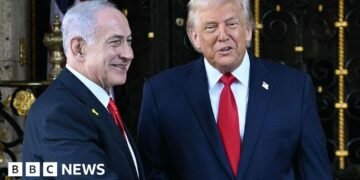
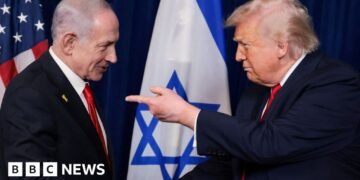
Israel’s Prime Minister Benjamin Netanyahu has accepted an invitation to join U.S. President Donald Trump’s newly established Board of Peace, which aims to address conflicts around the world. This move is significant as it underscores Israel’s involvement in a broader peace initiative that many believe seeks to redefine international peace efforts, particularly in relation to ongoing tensions in Gaza.
Why It Matters
The Board of Peace is perceived by some as a strategic shift from traditional international mediators, such as the United Nations, and raises questions about its potential effectiveness in resolving long-standing disputes. Particularly, its lack of mention of Palestinian territories in the initial charter has caused concern among critics, suggesting that it may not adequately address the complexities surrounding the Israeli-Palestinian conflict.
Key Developments
- Netanyahu’s office confirmed his participation in the board, which aims to recruit other world leaders.
- The United Arab Emirates, Bahrain, Albania, Armenia, Azerbaijan, Belarus, Hungary, Kazakhstan, Morocco, and Vietnam have also agreed to join the initiative.
- Notably, Canada, Russia, Turkey, and the UK have been invited but have not publicly commented.
- Some countries, such as Norway, France, and Sweden, have voiced reservations and declined to participate, citing concerns about the current proposal.
- According to a leaked draft of the board’s charter, members will serve renewable three-year terms but can secure a permanent seat through substantial financial contributions.
- Trump will serve as chairman, retaining authority to modify the board’s functions as needed.
Full Report
Leadership and Structure
President Trump will preside over the Board of Peace, assisted by an Executive Board that comprises significant figures, including U.S. Secretary of State Marco Rubio and former British Prime Minister Tony Blair. Notable appointments also include Trump’s son-in-law Jared Kushner and former UN Middle East envoy Nickolay Mladenov, who will engage with Palestinian structures during the board’s activities.
International Reactions
While several countries have agreed to join, others express skepticism. Norway rejected participation, citing unresolved questions regarding the proposal. France and Sweden have similarly indicated their intention to abstain, highlighting potential disagreements over the board’s approach to international conflict resolution.
Dynamics in Gaza
The board is expected to take transformative steps, aiming to facilitate the reconstruction and demilitarization of Gaza. A framework has been established where a technocratic government in Gaza is envisioned to restore public services and instate governance. However, any actual progress faces high stakes, with challenges from Hamas, which has previously insisted on maintaining its arms in exchange for statehood.
Fragile Ceasefire
The previous ceasefire has been fragile since its inception, marked by ongoing violence. Since the ceasefire began, there have been reports of over 460 Palestinians killed in Israeli airstrikes, while the Israeli military has reported casualties among its forces due to Palestinian attacks. This ongoing conflict erupted after a significant attack by Hamas that claimed the lives of numerous individuals in southern Israel.
Context & Previous Events
The recent violence began with a Hamas-led attack on October 7, 2023, resulting in substantial casualties on both sides. In the wake of escalating tensions, Hamas and Israel agreed to a ceasefire, permitting a limited exchange of hostages and a partial withdrawal of Israeli forces. However, the prospect of sustaining peace remains uncertain amid unresolved issues surrounding arms and sovereignty.