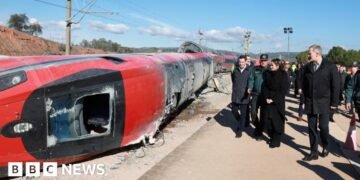























Spain is reeling from a tragic high-speed train crash that occurred on Sunday, claiming at least 42 lives and marking the country’s deadliest rail incident in over ten years. As the nation mourns this catastrophic loss, questions arise regarding the potential causes behind the derailment that has shaken one of Europe’s most respected rail systems.
This tragedy is not merely a loss of lives but raises concerns about the safety and reliability of Spain’s high-speed rail infrastructure, which has long been seen as a hallmark of modernization and efficiency in transportation. The investigation into the causes of the derailment could have significant implications for the future of the rail system and its operational standards.
Key Developments
- The collision between a train traveling from Málaga and an oncoming train resulted in the derailment of both vehicles.
- A rail investigation committee, CIAF, has initiated an analysis to determine the cause of the accident.
- Initial findings suggest that human error is unlikely since both trains were within safe speed limits.
- Investigators are focusing on carriage number six of the train and examining the track for signs of damage.
- Concerns about railway infrastructure have been highlighted, as Adif, the rail infrastructure administrator, had previously noted technical issues in the area.
Full Report
Investigation Underway
In the aftermath of the devastating collision in southern Spain, the CIAF rail investigatory commission has begun its detailed examination of the derailed train, which was manufactured by the Italian company Iryo in 2022. The train’s carriage number six, identified as the first to derail, is being scrutinized for evidence that could help elucidate the events leading to the crash. Transport Minister Óscar Puente emphasized the importance of this analysis, stating it would provide many answers to the complex situation.
Track Condition Concerns
Investigators are also evaluating the condition of the track on which the derailment occurred. Reports indicate that sections of the track were found to be damaged. While this raises speculation regarding its potential role in the accident, the Spanish government has advised caution, suggesting that such damage may have been a result of the crash’s impact rather than a precursor to it.
Administrative Warnings
In the months leading up to the crash, the rail infrastructure administrator, Adif, highlighted several technical concerns regarding the line where the accident occurred. Some of these issues related specifically to signaling, with a recent Senate discussion emphasizing the need for improvements. Additionally, a speed limit reduction has been enforced on a significant stretch of the AVE line due to infrastructure concerns.
Public Reactions
The mood of the nation has been somber, with citizens expressing both grief and anxiety over the state of rail travel in Spain. Social media platforms are flooded with posts from passengers who recalled uncomfortable experiences while traveling on AVE trains, with a report from a user about vibrations causing safety concerns for them and their child. The train drivers’ union, Semaf, previously issued warnings regarding the safety and comfort of AVE services, advocating for speed limit reductions to mitigate risks.
Government Response
Prime Minister Pedro Sánchez has pledged transparency in the investigation, assuring that all findings will be shared with the public to promote understanding and accountability. He also announced a three-day mourning period for the victims, reflecting the widespread impact of the tragedy on the Spanish populace.
Context & Previous Events
The current incident marks the worst rail disaster in Spain since the Santiago de Compostela derailment in 2013, which resulted in 80 fatalities. Unlike that event, however, which involved a train traveling at high speed, the crash on Sunday took place on the oldest segment of the AVE system, used for the Madrid-Andalusia route. Since its launch in 1992, Spain’s high-speed rail network has been celebrated for its modernization efforts, supported by European Union funding to enhance efficiency and safety in public transport.