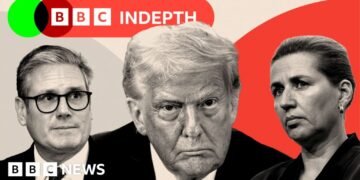























Tensions Rise as Trump Maneuvers for Greenland Control
President Donald Trump’s recent insistence that the U.S. needs Greenland for national security has reignited tensions between the United States and Europe, creating unease among European nations and raising questions about transatlantic relations.
Why It Matters
The implications of Trump’s remarks extend beyond geopolitics, as they could threaten economic stability in Europe while altering long-standing alliances. European governments are navigating a complex situation where they must respond to threats of tariffs and potential geopolitical shifts.
Key Developments
- Trump stated that Greenland is crucial for U.S. national security, prompting queries about possible military action. His response, "No comment," has escalated fears in Greenland.
- The U.S. is pressuring Denmark’s allies in NATO and the EU, threatening punitive taxes on exports if they do not support American control over Greenland.
- Germany and France stood firmly against potential U.S. economic blackmail, asserting that they would not succumb to intimidation over trade.
- EU officials are contemplating retaliatory tariffs amounting to €93 billion against U.S. goods if the Greenland situation escalates.
- The European Union is adopting a dual strategy of diplomacy while also preparing for strong repercussions if necessary.
Full Report
Tensions Escalate Over Greenland
President Trump’s renewed focus on acquiring Greenland has sparked alarm amongst its inhabitants and European officials alike. The semi-autonomous territory of Denmark, which is a member of both NATO and the EU, has found itself at the center of this unfolding diplomatic drama. Trump’s comments suggest an assertive approach, leaning on other nations to abandon Danish sovereignty while warning of potential tariffs on exports to the U.S.
European Response
European leaders are increasingly vocal about their discontent. Germany’s finance minister, Lars Klingbeil, emphasized that Europe must brace for consequences and will not be blackmailed. Similarly, France’s Finance Minister Roland Lescure lamented a shift in historic alliances, noting that the use of tariffs as a geopolitical tool is unprecedented in their long-standing relationship with the U.S.
European diplomats are hoping for a more conciliatory approach from Trump during the upcoming Global Economic Forum in Switzerland. Their strategy involves offering support for U.S. Arctic security interests while standing firm against potential tariff threats.
Potential Economic Fallout
Should Trump pursue punitive tariffs over Greenland, experts warn of significant repercussions for both economies. European investments in the U.S. contribute substantially to American jobs, with around 3.4 million Americans employed by EU investors. A retaliatory trade war could damage these ties and inflate consumer costs on both sides of the Atlantic.
Context & Previous Events
This situation is not the first time that President Trump has sparked controversy over foreign policy and trade practices. Past tariffs on various goods have resulted in similarly strained dialogues between the U.S. and European nations. Each new statement from the Trump administration appears to push transatlantic relations into more fraught territories. The EU’s response strategy emphasizes a commitment to defend national sovereignties amidst increasing U.S. unilateralism and unpredictability.