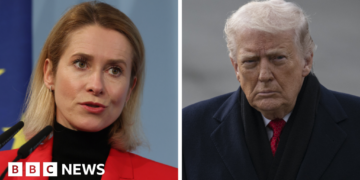























Trump Stands Firm on Greenland Tariffs Amid European Opposition
In a recent escalation of rhetoric, President Donald Trump affirmed his commitment to impose tariffs on European nations opposing his controversial proposal to acquire Greenland. With Denmark and other European allies firmly supporting Greenland’s sovereignty, the potential for heightened economic tensions and geopolitical conflict looms large.
The unfolding drama highlights significant issues surrounding territorial rights and international diplomacy, particularly as the European Union prepares for an emergency summit to address Trump’s demands. The stakes are heightened by existing tensions in the region, including the war in Ukraine and NATO’s ongoing role in security matters.
Key Developments
- President Trump vows to impose a 10% tariff on goods imported from the UK and seven other NATO allies starting February 1, escalating to 25% by June if his demands for Greenland are not met.
- European leaders, including Denmark’s foreign minister, have publicly rejected Trump’s threats, affirming Greenland’s sovereignty belongs to its indigenous people and Denmark.
- Trump indicated he would consider all measures, abstaining from ruling out military actions when questioned about seizing Greenland.
- The European Union will convene an emergency summit in Brussels to discuss Trump’s actions and their implications for international relations.
Full Report
Tariff Threats and Responses
In a bold statement, Trump articulated his intention to levy tariffs on goods from the UK, Denmark, Norway, Sweden, France, Germany, the Netherlands, and Finland. He specifically stated that the tariffs would initiate at 10% and would increase to 25% unless a deal to purchase Greenland is struck. Responding to these threats, Danish foreign minister Lars Løkke Rasmussen emphasized that Copenhagen has “red lines that can’t be crossed” and called for a diplomatic resolution instead of economic coercion.
European Unity and Sovereignty
European leaders have rallied in defense of Greenland’s sovereignty, with UK Foreign Secretary Yvette Cooper insisting that the future of the territory is for its inhabitants and Denmark alone to determine. EU foreign policy chief Kaja Kallas reiterated that the bloc has no interest in escalating the conflict but asserts that “sovereignty is not for trade.”
Implications for NATO and Regional Security
Denmark has warned that any U.S. military action in Greenland could significantly undermine NATO’s framework. In a symbolic gesture of support, some European NATO members recently deployed troops to Greenland. NATO Secretary General Mark Rutte confirmed that the alliance would continue to collaborate with Denmark and Greenland on Arctic security issues in light of the situation.
Trump’s Commentary and Diplomatic Dynamics
In a separate exchange, Trump seemed to minimize European concerns by suggesting that they should focus on the ongoing conflict with Russia and Ukraine, a statement that drew attention to existing geopolitical pressures. His comments were made during an NBC News interview, where he cryptically refrained from confirming or denying if he would use military force to secure Greenland, instead opting for a vague “no comment.”
Context & Previous Events
Recently, the U.S. and Canada, through the North American Aerospace Defense Command, announced the deployment of multiple aircraft to the Pituffik Space Base in Greenland, emphasizing that these missions are part of routine operations coordinated with Denmark and Greenland’s government. This action, reflective of ongoing military collaboration, adds another layer to the already complex relationship between the U.S. and its European allies regarding Arctic sovereignty issues and territorial integrity.