






















UN Chief Warns of Erosion of International Law Amid U.S. Power Politics
As the United Nations faces ongoing challenges around the globe, Secretary-General António Guterres has expressed deep concerns about the decline of international law and multilateralism, particularly in light of the United States’ recent actions. Guterres believes that the U.S. is prioritizing power over established legal norms, undermining the fundamental principles upon which the UN was founded.
Why It Matters
The erosion of international law could have significant implications for global stability, peace, and cooperation. Guterres’ warnings highlight a growing skepticism toward multilateral solutions, particularly from powerful nations. His remarks come at a time when conflicts and humanitarian issues escalate worldwide, raising critical questions about the future effectiveness of the UN in resolving such crises.
Key Developments
- U.S. Actions Under Scrutiny: Guterres criticized the U.S. for seemingly prioritizing its power over international legal frameworks, citing recent actions in Venezuela and threats regarding Greenland.
- Calls for UN Reform: He emphasized the need for reform within the UN Security Council to ensure it reflects the current geopolitical landscape and regains its legitimacy.
- Increased Conflict and Inequality: Guterres pointed to a world marked by conflict, impunity, and violations of international law as some of the most pressing challenges faced by the UN.
- Gaza Humanitarian Crisis: He addressed the recent humanitarian challenges in Gaza, noting the obstacles UN operations faced due to restrictions imposed by Israel.
Full Report
U.S. Dominance in Global Affairs
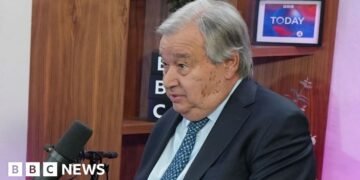
In a recent interview, Guterres asserted that the U.S. appears to disregard multilateral solutions in favor of unilateral actions that emphasize its dominance. He referenced shifting U.S. policies, which he sees as ignoring international norms. Guterres posited that this trend threatens the foundational principle of equality among member states, which is central to the UN’s mission.
Critique of the Security Council
During his discussion, Guterres highlighted the ineffectiveness of the UN Security Council, which is designed to maintain international peace and security. Currently, the council’s five permanent members possess veto power, which has often been used to protect individual national interests rather than serve collective global needs. Guterres called for a restructuring that would give more voice to underrepresented nations and limit veto powers to facilitate meaningful resolutions.
Challenges in Humanitarian Assistance
Guterres addressed the challenges the UN has faced in providing humanitarian aid in conflict zones like Gaza. He noted that Israel’s controls prevented effective distribution of essential aid, emphasizing that the UN was prepared to act but hampered by external restrictions. He underscored the need for unhindered humanitarian access during crises.
Context & Previous Events
Guterres, who has served as UN Secretary-General since 2017, will complete his term at the end of this year. He has publicly reflected on the increasing chaos in international politics, highlighting rising inequalities and the growing tendency of powerful nations to sidestep established legal frameworks. This comes amidst ongoing conflicts, including the U.S. intervention in Venezuela and the humanitarian issues stemming from the Israeli-Palestinian conflict. The need for the UN to adapt to contemporary challenges has never been more pressing, as pointed out in Guterres’ recent General Assembly address.