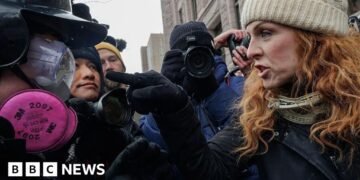























Rising Tensions in Minnesota Amid Ongoing Immigration Protests
Amid an escalating situation in Minnesota, tensions are surging as protests persist against President Trump’s immigration strategies, which are met with federal law enforcement increasing their visibility and operations in the region. The deployment of additional resources, including 1,500 troops on standby, amplifies concerns among local residents as they rally for the rights of immigrants amidst a campaign perceived as harsh and aggressive.
Why It Matters
The protests reflect deep divides in American society regarding immigration policy and law enforcement practices. Minneapolis has become a focal point, embodying the contention between the federal government’s strategy to enforce immigration laws and local communities’ fight against perceived injustices and racial profiling. The outcomes of these clashes hold implications not just for Minnesota but across the nation as debates over immigration continue to influence political landscapes.
Key Developments
- Minnesota residents are actively monitoring U.S. Immigration and Customs Enforcement (ICE) agents, claiming a legal right to observe their activities.
- Following recent confrontations, including the fatal shooting of a local woman by an ICE agent, law enforcement deployed tear gas and pepper balls to manage protests.
- A federal judge has issued restrictions on ICE’s crowd control tactics against peaceful demonstrators, stating that peaceful protesters cannot be arrested or subjected to pepper spray.
- The Trump administration continues its commitment to heightened immigration enforcement despite mounting local opposition.
Full Report
Community Actions
Local residents, banded together in informal groups, are actively tracking ICE movements using vehicles to document their activities. A participant, who chose the pseudonym Sunshine for safety reasons, asserts, "I have decided for my own safety to give them more space," referring to ICE agents. The residents believe that observing these agents is crucial to ensuring accountability. Minnesota officials have acknowledged the generally peaceful nature of protests, although tensions have occasionally resulted in confrontations.
Federal Response and Controversies
In a significant escalation, President Trump and the Department of Homeland Security have signaled intentions to maintain strong immigration enforcement, asserting the imperative to target the "worst of the worst." However, critics argue that this approach unfairly impacts individuals with no criminal backgrounds. The death of Renée Good, a local woman shot by an ICE agent, further complicates the narrative, with varying accounts of the incident leading to increased scrutiny of ICE practices.
A recent shooting involving a federal officer added to local unrest, as conflicting accounts emerged regarding the circumstances of the shooting. The DHS claimed the officer acted in self-defense, following an attempted arrest, while the family of the individual shot disputed this version of events.
Protests and Pushback
In tandem with ICE’s operations, protests have ramped up, countering rallies organized by pro-ICE advocates. Demonstrators in favor of immigration enforcement have faced significant opposition from local activists, highlighting the stark divide in public opinion. Meanwhile, Governor Tim Walz has criticized the Trump administration for politicizing the situation amid a recent welfare fraud scandal involving some members of the Somali community, a predominant demographic in Minnesota.
Context & Previous Events
This latest wave of protests is situated within a broader effort by the Trump administration to initiate the largest deportation operation in U.S. history, following a pattern of aggressive immigration policies. Minnesota is the fifth major city targeted under this broadened enforcement strategy, with federal agents mobilizing in response to continuing activism and protests against these measures. As President Trump threatens further military intervention, local activists remain committed to opposing federal actions they perceive as unjust and racially motivated, while the national conversation around immigration continues to evolve.