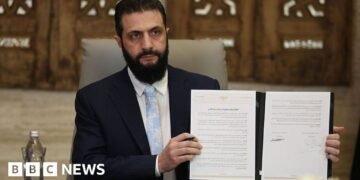























Syrian Government Announces Nationwide Ceasefire with Kurdish Forces
The Syrian government has declared an immediate nationwide ceasefire with the Kurdish-led Syrian Democratic Forces (SDF), marking a pivotal step in the ongoing conflict. This ceasefire ends nearly two weeks of intense fighting and is part of a comprehensive agreement aimed at integrating the SDF into Syrian state structures.
Why It Matters
This development holds significant implications for Syria’s future stability and governance. By reasserting control over key regions and integrating Kurdish forces into the national military framework, the Syrian government seeks to unify its territorial integrity and diminish the long-standing autonomous administration established by the SDF. The agreement may also shape U.S. involvement in the region, as the SDF was previously a crucial ally in the battle against ISIS.
Key Developments
- The ceasefire concludes approximately two weeks of conflict between Syrian forces and the SDF.
- A 14-point agreement will facilitate the integration of the SDF into Syria’s military and state institutions.
- President Ahmed al-Sharaa announced the deal will restore control over al-Hasakah, Deir Ezzor, and Raqqa.
- U.S. special envoy Tom Barrack described the agreement as progress toward achieving a "unified Syria."
- SDF commander Mazloum Abdi was unable to attend the announcement due to weather issues, with a postponed meeting planned.
- Under the agreement, Syrian authorities will oversee civilian institutions, border crossings, and key oil and gas fields.
- The SDF’s military and security personnel will join Syria’s defense and interior ministries post-vetting.
- Damascus will now manage prisons holding foreign ISIS fighters and their families.
- The agreement includes recognition of Kurdish cultural and linguistic rights, marking a historic acknowledgment since Syria’s independence in 1946.
Full Report
Ceasefire Declaration and Agreement
The ceasefire announced by the Syrian government effectively puts an end to nearly two weeks of hostilities with the Kurdish-led SDF. President Ahmed al-Sharaa detailed the agreement, which encompasses the reintegration of the SDF into the Syrian state’s military and governance structures. This includes reclaiming control over strategically important regions in eastern and northern Syria.
U.S. envoy Tom Barrack commended the deal as a significant advancement toward unifying the country. The dialogue between al-Sharaa and Barrack reflects international interest in stabilizing the region amid ongoing tensions.
Integration and Acknowledgment of Kurdish Rights
The agreement signed by government and SDF representatives stipulates that the Syrian authorities will take over various civilian institutions and critical resources, including border crossings and oil fields crucial to Kurdish self-rule. The SDF forces will be incorporated into national defense and interior frameworks after undergoing a vetting process.
Significantly, the agreement sees the Syrian government pledging to recognize Kurdish cultural rights, which includes granting Kurdish the status of an official language and designating the Kurdish New Year as a national holiday. This acknowledgment represents a breakthrough for Kurdish rights within a framework that has often marginalized their identity.
Implications for U.S. Involvement
The deal reaffirms Syria’s participation in the U.S.-led coalition against ISIS, highlighting the ongoing relevance of international partnerships in the region. The Kurdish forces, previously bolstered by U.S. support, played a crucial role in combating ISIS, and their future role in the Syrian military could further influence U.S. dynamics in the area.
Context & Previous Events
The backdrop for this ceasefire stems from the SDF’s establishment of an autonomous administration during the Syrian civil war nearly a decade ago, with significant backing from the United States. Previous attempts at integrating SDF forces into national frameworks have stalled, creating a situation where a portion of Syria remained under militia control.
The announcement occurred shortly after Syrian forces moved into areas previously controlled by the SDF, underscoring the shifting dynamics of power in this conflict-ridden region.