






















U.S. Tariffs on Allies Ignite Tensions Over Greenland
Protests erupted in Greenland and multiple cities in Denmark following U.S. President Donald Trump’s controversial tariff announcement aimed at eight European allies. This move comes as tensions rise over Trump’s attempts to acquire the resource-rich territory of Greenland, underscoring a growing rift between the United States and its traditional allies.
Why It Matters
The tariffs, which could escalate from 10% to 25%, threaten not only economic relations but also challenge NATO’s unity. As European leaders rally to support Denmark’s sovereignty over Greenland, the situation raises questions about U.S. intentions in the Arctic region and the integrity of diplomatic relations among allies.
Key Developments
- President Trump announced that a 10% tariff on imports from Denmark, Norway, Sweden, France, Germany, the UK, the Netherlands, and Finland will begin February 1, with a potential increase to 25%.
- European leaders, including UK Prime Minister Keir Starmer and French President Emmanuel Macron, condemned the tariff as "completely wrong" and "unacceptable."
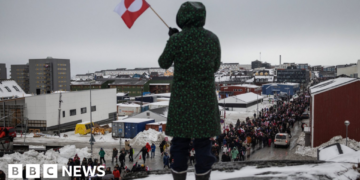
- Thousands of protesters rallied in Nuuk, Greenland, and Copenhagen with signs reading "Hands Off Greenland."
- Opinion polls indicate that 85% of Greenlanders oppose U.S. acquisition of the territory.
- Trump stated the tariffs would persist until a "Complete and Total purchase" of Greenland is agreed upon.
Full Report
Escalating Tensions
During a post on his Truth Social platform, President Trump emphasized the importance of Greenland for U.S. security, saying the region is critical for missile detection and monitoring Arctic maritime activity. He framed the tariff move as a response to a "dangerous game" being played by the affected countries.
Several European leaders swiftly condemned the tariff announcement, asserting that it is inappropriate to impose punitive measures on allies engaged in collective security. Prime Minister Starmer remarked, “We will of course be pursuing this directly with the US administration," while Macron insisted that "tariff threats are unacceptable."
Protests Across Greenland
Meanwhile, demonstrations arose across both Greenland and Denmark, with protestors advocating for Greenland’s right to self-determination. In Nuuk, Prime Minister Jens-Frederik Nielsen joined protestors bearing banners stating "Greenland is not for sale" as they marched toward the U.S. consulate. Similar sentiments echoed in Copenhagen, where rally-goers showcased banners like "Greenland for Greenlanders."
A Surprising Announcement
The tariff announcement was unexpected, especially in light of prior discussions between U.S. and Danish officials to form a working group on Greenland’s future. This juxtaposition raised concern among diplomatic and political circles in Washington, many of whom viewed the high-level talks as a potential deterrent to further U.S. actions regarding Greenland.
Context & Previous Events
Trump has often expressed a desire to acquire Greenland, referring to it as vital for U.S. national security. In earlier statements, he suggested that the U.S. could pursue this acquisition "the easy way" or "the hard way." Furthermore, a recent agreement for joint military reconnaissance in Greenland between Denmark and several EU nations was perceived as a diplomatic success that could ease tensions.
With the Arctic’s strategic importance increasing, European countries underscore that the region’s security should be a NATO collective responsibility, further complicating the current U.S. stance.