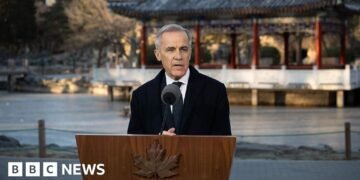























Canada Recalibrates Trade Relations with China Amid US Uncertainty
Prime Minister Mark Carney’s administration has initiated a pivotal shift in Canada’s foreign policy by forming a new trade agreement with China, significantly easing tariffs on Chinese electric vehicles while receiving concessions on key Canadian agricultural exports. This move marks a departure from traditional dependencies on the United States, signaling a new strategy in uncertain times.
Why It Matters
This agreement underscores Canada’s increasing autonomy in foreign trade relations, particularly given the unpredictability associated with the U.S., its primary trade partner. As global dynamics evolve, Canada’s decision reflects a pragmatic approach to securing its economic interests while navigating strained ties with the American administration.
Key Developments
- Canada will reduce tariffs on Chinese electric vehicles from 100% to 6.1% for a quota of 49,000 vehicles, with potential increases in the future.
- In return, China will cut tariffs on Canadian canola seeds from 84% to around 15% by March 1, with additional commitments to eliminate tariffs on various Canadian agricultural products and reduce visa restrictions for Canadian visitors.
- Reactions from Canadian provincial leaders are mixed, with some expressing optimism about economic relief and others warning of potential job losses in Canada’s auto sector.
- U.S. officials have labeled the agreement as "problematic," with mixed responses from the Trump administration, which has also acknowledged the deal’s potential benefits.
Full Report
New Trade Agreement Details
The newly formed agreement between Canada and China signals a strategic pivot for Canada, which has faced ongoing tension with the United States. Prime Minister Carney articulated that this shift allows Canada to engage with the global landscape "as it is," rather than how it would prefer it to be. The agreement will ease significant tariffs on Chinese electric vehicles, aiming to introduce competitive pricing in the Canadian market.
Provincial Reactions
The response among provincial leaders has been diverse. Saskatchewan Premier Scott Moe welcomed the agreement as a positive economic development, particularly for farmers who have struggled under previous Chinese tariffs affecting canola oil. Conversely, Ontario Premier Doug Ford criticized the deal, warning of detrimental impacts on the Canadian auto industry, arguing that this could invite an influx of affordable Chinese vehicles without adequate investments in local manufacturing.
Broader Implications
Experts suggest that Canada’s decision to engage with China more directly could yield increased competition in the electric vehicle sector, with up to 10% of Canadian EV sales projected to go to Chinese manufacturers. This development is likely to pressure American competitors, including Tesla, as they attempt to secure a foothold in Canada amidst changing market conditions.
U.S. Reaction
In the United States, the agreement has garnered a mixed reception. U.S. Trade Representative Jamieson Greer expressed concerns over potential regrets Canada may face from this decision. President Trump, on the other hand, described it as a favorable development, noting the importance of dialogue with China.
Context & Previous Events
Mark Carney’s administration has previously deemed China a substantial security threat to Canada. The recent agreement comes against a backdrop of tariff escalations initiated by the Trump administration, which have contributed to economic uncertainty in the North American trade landscape. The United States-Mexico-Canada Agreement (USMCA) is currently under review, adding to the complexities of trilateral trade relations at this juncture.
As Canada recalibrates its international partnerships, its recent deal with China represents not only a strategic economic decision but also a necessary adaptation to the evolving geopolitical landscape.