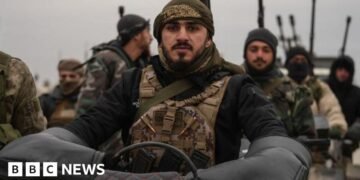























Syrian Forces Enter Deir Hafer as Kurdish Military Withdraws
Syrian troops have begun their advance into Deir Hafer, a town situated approximately 50 kilometers east of Aleppo, following a decision by Kurdish forces to withdraw. This development marks a pivotal shift in the dynamics between the Syrian government and the Kurdish Syrian Democratic Forces (SDF), who have engaged in negotiations with U.S. officials.
Why It Matters
The ongoing tension and military maneuvers in northern Syria highlight the fragile balance of power in the region. The Kurdish withdrawal from areas they controlled raises questions about the future of Kurdish rights within Syria, especially following recent pledges by Syrian President Ahmed al-Sharaa that aim to integrate Kurdish bodies into national institutions. This realignment could alter the long-standing governance structures in Syria and affects regional stability amid ongoing humanitarian concerns.
Key Developments
- Syrian forces have reported full military control of the town of Deir Hafer.
- Kurdish forces are redeploying east of the Euphrates River, following discussions with U.S. officials.
- President al-Sharaa has pledged to recognize Kurdish as a national language and establish new holidays for the Kurdish community.
- At least 4,000 civilians have fled Deir Hafer as the Syrian army intensified operations.
- Both the SDF and Syrian military have accused each other of violating recent agreements.
Full Report
Military Advances and Civilian Impact
The Syrian army has started to establish control over Deir Hafer, a strategic town that has been under Kurdish management. The military’s operations commenced as Kurdish forces announced they would redeploy towards the east of the Euphrates River, inspired by conversations with U.S. officials. In light of increased military activity, the Syrian army has urged civilians to evacuate, with thousands reportedly leaving the area.
Kurdish Negotiations and Government Responses
During discussions with U.S. diplomats, Kurdish leader Mazloum Abdi agreed to the withdrawal of the SDF. President al-Sharaa’s recent announcements included making Kurdish a recognized national language and designating the Kurdish New Year as an official holiday, a significant concession recognizing Kurdish rights in the predominantly Arab nation.
Statements from Both Sides
Despite gradual easing of tensions, allegations of violations have emerged from both factions. The Syrian military claims that Kurdish forces have killed two soldiers amid the operations, while the SDF contends that Damascus prematurely escalated military presence in the region. The declaration by the Kurdish administration regarding the government’s recognition of Kurdish rights is a positive step, yet they have called for a more permanent constitutional framework to formalize these changes rather than relying on temporary decrees.
Context & Previous Events
Historically, Kurds in Syria have faced significant oppression, particularly before the civil war that began in 2011, when many assumed control of substantial territories in the north and northeast of the country. Following the ousting of Bashar al-Assad in late 2024, President al-Sharaa has prioritized integrating Kurdish entities into national structures. In March 2025, the SDF entered into an agreement with the Syrian government aimed at this integration, though implementation has encountered obstacles, with blame cast by both sides for the lack of progress.






