






















Venezuelan Leader María Corina Machado Optimistic for Democratic Transition
In a recent press conference in Washington, Venezuelan opposition leader María Corina Machado expressed confidence in her nation’s eventual transition to democracy, particularly following the ousting of former President Nicolás Maduro by U.S. military action. However, she refrained from discussing specific plans regarding her return to Venezuela or the timeline for future elections in the country.
Why It Matters
Machado’s optimistic outlook reflects a critical moment for Venezuela as it navigates through political turmoil and uncertainty. The U.S. government’s stance and ongoing diplomatic efforts will significantly impact the opposition’s strength and the possibility of restoring democratic governance in a nation long plagued by authoritarian rule.
Key Developments
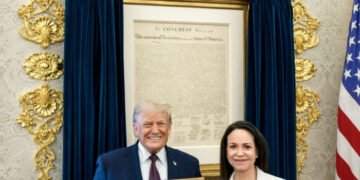
- Machado met with former President Donald Trump, presenting him with her Nobel Peace Prize, a gesture indicating her desire for renewed American support for democracy in Venezuela.
- Despite her attempts to engage with the Trump administration, Machado was sidelined in favor of Delcy Rodríguez, Maduro’s former vice president, who has been positioned as the White House’s preferred leader for the time being.
- CIA Director John Ratcliffe visited Venezuela to meet with Rodríguez, solidifying her role as the acting president.
- Machado asserted her confidence in a "profoundly orderly transition" to democracy but did not provide details on her movement’s strategy or the human rights situation in Venezuela.
Full Report
Optimism Amidst Uncertainty
During her appearance at the Heritage Foundation, Machado stated she remains "profoundly, profoundly confident" that there will be a transition to democracy in Venezuela. She claimed that this change would transform Venezuela’s self-identified socialist government into a strong ally of the United States. However, she downplayed the idea that Trump’s support for Rodríguez was a slight against her, emphasizing that it was not a matter of competition between them.
Machado chose not to elaborate on discussions held with Trump, suggesting that she felt no need to advise the president on the specifics of U.S. involvement in Venezuela.
A Symbolic Gesture
Her meeting with Trump included her bestowing upon him the Nobel Prize she earned last year, recognizing his commitment to Venezuelan freedom. However, it is important to note that the Nobel Institute has clarified that the award is not transferable.
Trump, who has been vocal about seeking recognition for his own achievements and has shown interest in Venezuela’s oil industry, acknowledged Machado warmly but expressed skepticism about her ability to lead due to a perceived lack of support within Venezuela.
Election Challenges
Machado campaigned extensively ahead of the 2024 presidential elections, garnering support from millions eager for change after decades of single-party dominance. Nevertheless, after being disqualified from participating, she was replaced on the ballot by Edmundo Gonzalez, an unknown diplomat. Despite credible reports suggesting widespread electoral fraud, Maduro was declared the victor by officials loyal to his regime.
Following her disqualification, Machado went underground but later reemerged to accept her Nobel Prize in Norway, marking her first international trip in over a decade.
Context & Previous Events
The political climate in Venezuela has been dominated by the rule of Nicolás Maduro, whose government has faced criticism for human rights abuses and electoral fraud. With the U.S. military’s involvement in the region and shifting diplomatic strategies, the opposition, including Machado, is hoping for a renewed push toward establishing democratic norms in Venezuela.
This article is reflective of the ongoing tensions and developments surrounding Venezuela’s political landscape and should provide readers with a clear overview of the current situation.