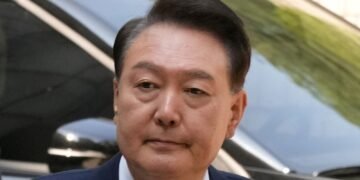























Former South Korean President Sentenced to Five Years in Prison
The former president of South Korea, Yoon Suk Yeol, has received a five-year prison sentence for his controversial attempt to impose martial law. The ruling comes as a significant decision in a case that highlights the tensions between political power and legal standards in the country.
Why It Matters
This ruling underscores the legal and ethical limits of presidential authority in South Korea, where the balance of power is an ongoing challenge. Yoon’s actions and the court’s response have sparked widespread public interest and could have implications for future administrations, while simultaneously igniting debates over the politicization of the judiciary.
Key Developments
- Yoon was found guilty of obstructing justice by utilizing the presidential security service to prevent law enforcement from executing an arrest warrant against him.
- He was also convicted of falsifying official documents and failing to adhere to required legal procedures for declaring martial law.
- The Seoul Central District Court’s ruling is the first in a series of legal challenges Yoon faces stemming from his controversial martial law declaration on December 3, 2024.
- Yoon plans to appeal the sentence, asserting that his actions were within presidential authority and citing threats from a liberal-controlled parliament as justification.
- Prosecutors are pursuing additional charges, including the potential imposition of the death penalty for alleged insurrection activities linked to the martial law declaration.
Full Report
Judge’s Critique
The presiding judge emphasized that Yoon exploited his presidential influence to obstruct lawful processes, indicating that Yoon’s decisions favored personal safety and gain rather than the public interest. The court noted a distinct lack of remorse from Yoon during the proceedings.
Yoon’s Defense
In his defense, Yoon has maintained that his martial law declaration was a necessary measure to safeguard the state against threats posed by a prevailing liberal parliament perceived to be hindering his objectives. He clarified that he never intended for martial law to last an extended duration, suggesting it was a temporary measure.
Legal Proceedings
Yoon’s legal team has signaled intentions to contest the verdict, describing the ruling as politically motivated. His defense attorney, Yoo Jung-hwa, expressed disappointment over the decision, framing it as a product of political bias rather than legal principles.
Background on Arrest
Yoon’s legal troubles began when he barricaded himself in his residence and instructed security forces to thwart investigators attempting to serve an arrest warrant. His eventual arrest in January prompted widespread demonstrations advocating for his resignation, reflecting significant public discontent around his presidency.
Context & Previous Events
Yoon Suk Yeol’s attempt to impose martial law was quickly overturned by the South Korean parliament within hours, leading to significant public protests calling for his ouster. Subsequently, he was impeached later that December and formally removed from office by the Constitutional Court in April. Following these events, Yoon has faced multiple criminal charges, including allegations of orchestrating a rebellion in connection with the martial law attempt.