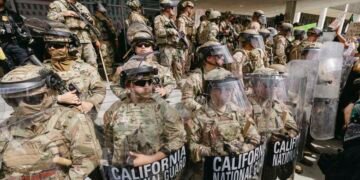























Legal Battles Over National Guard Deployments in Democratic States
In a significant legal battle, the Trump administration’s deployment of National Guard troops to California, Illinois, and Oregon was halted, following a Supreme Court decision that favored the states. The controversial deployments, which came amid protests and heightened tensions surrounding immigration enforcement, highlighted the complexities of legal interpretations of federal authority.
The implications of this ruling are profound, raising questions about the balance of power between state governments and the federal administration. This ongoing conflict illustrates the stakes involved in the deployment of military resources within U.S. cities, particularly under contentious political circumstances.
Key Developments
- President Trump withdrew National Guard troops from California, Illinois, and Oregon after a Supreme Court ruling against the administration.
- The deployments were initiated in June 2025 to assist federal immigration enforcement amid protests, against the wishes of state governors.
- The legal framework for these actions relied on a rarely used 19th-century law that lacks precise definitions.
- Democratic attorneys general worked in coordination to contest the deployments, sharing legal strategies and resources.
- Federal judges issued temporary restraining orders in multiple states, preventing troop deployment.
- As the year concluded, the Supreme Court upheld a block on troops in Illinois, shaping future interpretations of military authority.
Full Report
Escalating Tensions and Deployments
In June 2025, President Trump ordered the deployment of over 4,000 California National Guard members to Los Angeles, a move that was met with fierce opposition from Governor Gavin Newsom and state officials. This deployment was part of a broader strategy by the Trump administration to assert federal control over immigration enforcement amid claims of violence and rising crime—assertions that were widely disputed by data and judicial scrutiny.
Following California, similar troop mobilizations were proposed for Illinois and Oregon. Democratic attorneys general from these states, including Rob Bonta of California and Dan Rayfield of Oregon, were already preparing for potential military deployments, anticipating that the administration might engage in such actions in urban areas post-election.
Legal Mechanisms and Challenges
The legal basis for the National Guard deployments rested on an archaic statute, 10 U.S.C. 12406, which includes vague language regarding terms like “rebellion” and “invasion.” This lack of clarity prompted state officials to pursue legal channels to challenge the federal government’s authority to act.
Bonta described the situation as “uncharted territories,” emphasizing the importance of establishing a solid legal foundation to prevent a dangerous precedent. Coordination between California, Oregon, and Illinois proved invaluable as they shared strategies and insights in real time, particularly as legal challenges unfolded.
Judicial Wins and Ongoing Preparedness
Legal efforts led to a series of temporary restraining orders from federal judges in multiple states, effectively blocking the troop deployments. As these court rulings progressed, the urgency became apparent; the stakes of these legal decisions could define the limits of federal military power within civilian contexts.
Following a Supreme Court ruling just before Christmas that upheld blocks against military deployment in Illinois—a decision significant for defining the law surrounding such actions—Trump announced the withdrawal of troops from all three states, at least for the time being.
Vigilance for Future Deployments
Despite recent victories, Bonta and his counterparts remain vigilant. The possibility of the Trump administration invoking other legal mechanisms, such as the Insurrection Act, looms, indicating that states must continue their preparations for potential challenges ahead.
Context & Previous Events
The conflict escalated significantly in 2025 when Trump began deploying National Guard troops against the express wishes of state governors, a move unprecedented in modern U.S. history. This pattern of action initiated a complex legal dispute, raising important questions about the use of military authority in civilian operations and the ongoing tug-of-war between state and federal powers.






