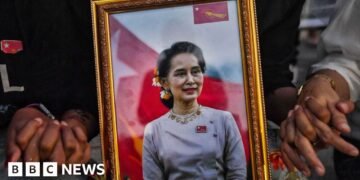























Aung San Suu Kyi’s Detention Exceeds Two Decades Amid Myanmar’s Turmoil
Aung San Suu Kyi, the prominent Burmese democracy advocate, has now spent 20 years under detention in Myanmar, including five years following the military coup that ousted her government in February 2021. While details surrounding her health and conditions remain scarce, her continued absence from public view raises urgent questions about her potential future role in Myanmar’s struggle for democracy.
Why It Matters
The protracted detention of Aung San Suu Kyi symbolizes the broader conflict engulfing Myanmar, where military rule has resulted in significant civilian casualties and widespread unrest. Her continued imprisonment underscores the ongoing repression of democratic movements in the country, impacting regional stability and international relations.
Key Developments
- Aung San Suu Kyi has been in detention for 20 years, with five years of that following the military coup in 2021.
- While the military junta claims she is in good health, her son raised concerns about her well-being.
- She has not had contact with her lawyers for two years and reportedly only sees prison staff.
- The military has imposed jail sentences totaling 27 years through charges widely considered fabricated.
- Despite her absence, calls for her release have persisted alongside demands for an end to the military’s aggression against opposition groups.
Full Report
Current Status and Public Perception
As of now, Aung San Suu Kyi is presumed to be held in a military prison in Nay Pyi Taw, with her family and the international community expressing concern about her fate. Her son, Kim Aris, highlighted the unsettling nature of her silence, stating, “For all I know, she could be dead.” In contrast, a spokesperson for the junta has assured the public that she remains in good health.
Despite her isolation, Aung San Suu Kyi continues to be an influential figure in Myanmar. Her image still appears in various forms, such as posters in discreet locations, suggesting ongoing support for her cause among the populace. Yet the realities of the current political landscape, marked by violence and civil conflict, pose significant challenges for any prospective reconciliation efforts.
Historical Context and Lessons Learned
Following earlier military rule, the situation in Myanmar shifted dramatically in 2010 when the junta allowed Aung San Suu Kyi to emerge from a prolonged detention and re-enter politics. This period was marked by tentative reforms and open dialogue, leading to her party’s victory in the 2015 election. However, a deeper analysis reveals that the same military, now emboldened, has opted for a more authoritarian approach, making any eventual political compromise seem unlikely now.
In stark contrast to past developments, the current military leadership appears more isolated, having resorted to extreme violence to suppress dissent. This hardened stance has cultivated a severely fragmented political atmosphere, with armed resistance gaining traction among disillusioned civilians. Aung San Suu Kyi’s previous strategy of non-violence seems increasingly obsolete in the face of escalating conflict.
Opposition and Future Prospects
While support for her leadership remains, criticism surrounding her previous governance has surfaced, particularly concerning her response to the Rohingya crisis. Many younger activists are increasingly vocal about her past decisions, complicating her once-unassailable stature as a freedom icon. If released, it remains uncertain how much influence she would exert on a fractured opposition and whether she would have the ability to unify or inspire a nation desperate for change.
Context & Previous Events
Aung San Suu Kyi’s political journey has been turbulent, characterized by lengthy imprisonment and subsequent waves of public support. After her release in 2010, she was able to lead her party and witnessed unprecedented electoral success in the 2015 elections. This trajectory abruptly reversed following the military coup in February 2021, marked by severe crackdowns on dissent and the attempt to eliminate her political presence. The junta’s reliance on authoritarian tactics starkly contrasts with earlier attempts at reform, establishing a more oppressive regime.