






















Denmark and US Engage in Tense Discussions Over Greenland’s Future
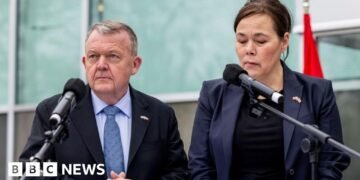
In a significant diplomatic exchange, Denmark’s foreign minister has highlighted a “fundamental disagreement” between the U.S. and Denmark concerning the future of Greenland. The talks at the White House, involving Vice President JD Vance and Secretary of State Marco Rubio, underscored the tensions surrounding U.S. intentions for the resource-rich territory, which President Trump insists is vital for U.S. national security.
Why It Matters
The ongoing controversy surrounding U.S. aspirations for Greenland has drawn international attention and concern from NATO allies, signaling deeper geopolitical tensions in the Arctic region. As global powers, including Russia and China, show increased interest in this strategically important area, the implications of U.S. actions in Greenland could reshape alliances and security dynamics for years to come.
Key Developments
- Denmark’s Foreign Minister Lars Lokke Rasmussen described the White House meeting as “frank but constructive,” despite ongoing disagreements over U.S. ambitions for Greenland.
- President Trump reiterated his desire to acquire Greenland, claiming it is critical for U.S. national security.
- Both Denmark and Greenland opposed any form of takeover but expressed openness to enhanced military collaboration.
- A high-level working group will be established to explore cooperative measures regarding the territory.
- Public sentiment in Greenland and the U.S. largely opposes the idea of U.S. control over the island.
Full Report
Diplomatic Tensions Emerge
During discussions at the White House, Rasmussen made it clear that Trump’s ambition to “conquer” Greenland is “totally unacceptable” to Denmark. The meeting, attended by U.S. officials including Vice President Vance and Secretary of State Rubio, resulted in no major breakthroughs, although all parties agreed to form a working group aimed at addressing the future of Greenland.
Security Concerns Raised
Rasmussen acknowledged an “element of truth” in Trump’s assertion that bolstering security in the Arctic is necessary to counter Russian and Chinese activities. However, he refuted Trump’s claims regarding the presence of foreign warships near Greenland, calling them “not true.” Greenland’s Foreign Minister Vivian Motzfeldt, following the talks, emphasized that while they are open to collaboration with the U.S., they oppose any form of territorial takeover.
International Support for Greenland
As tensions escalate, European allies have shown support for Greenland. Sweden has offered to deploy armed forces to the territory at Denmark’s request, while France plans to establish a consulate in Greenland. Germany has also announced intentions to send a reconnaissance team to explore military support options, reinforcing the notion that geopolitical tensions are extending to the Arctic.
U.S. Position on Greenland
Trump maintains that acquiring Greenland is crucial for the U.S. missile defense system known as Golden Dome, further complicating the diplomatic landscape. Yet, public opinion polls indicate widespread resistance to U.S. control over the island, with only 17% of Americans supporting the idea. As U.S. military operations expand in other regions, the focus on Greenland adds another layer to the ongoing narrative of American foreign policy.
Context & Previous Events
This latest round of talks follows Trump’s previously stated interest in acquiring Greenland, a topic that has caused diplomatic strains internationally. The U.S. has historically had military personnel stationed at its Pituffik base in Greenland, and under existing agreements with Denmark, has the ability to deploy troops as needed. However, there is no indication that Greenland or Denmark is willing to consider selling the territory.