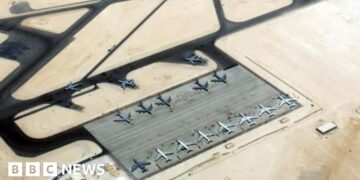























U.S. and UK Reduce Personnel at Al-Udeid Amid Rising Tensions with Iran
As tensions escalate surrounding Iran’s crackdown on anti-government protests, both the United States and the United Kingdom have initiated a partial withdrawal of personnel from the Al-Udeid air base in Qatar. This move is described by officials as a "precautionary measure" as President Donald Trump deliberates potential responses to Iran’s actions.
Why It Matters
The Al-Udeid air base is a crucial hub for U.S. military operations in the Middle East, housing approximately 10,000 American personnel and around 100 UK staff. The recent withdrawal signals heightened concerns about regional stability as well as risks to U.S. and allied forces amid increasing unrest in Iran, where government crackdowns have resulted in significant casualties.
Key Developments
- Partial withdrawal of U.S. and UK personnel from Al-Udeid is officially characterized as precautionary.
- U.S. embassy in Doha has raised travel advisories, urging enhanced caution and limiting non-essential movement to the base.
- Iran has closed its airspace temporarily, initially for two hours, later extending the closure due to escalating tensions.
- Multiple airlines, including Air India and Germany’s Lufthansa, are rerouting flights to avoid Iranian airspace.
- The situation follows stark warnings from Trump regarding potential U.S. military action against Iran if protest executions continue.
Full Report
Withdrawal Announced
The United States and the United Kingdom have begun reducing military presence at Al-Udeid, the largest U.S. military installation in the Middle East. Sources indicate that this decision comes amid fears of escalating conflict in the region as protests in Iran grow increasingly violent. The Qatari government has stated that these actions are a response to "current regional tensions."
Increased Caution Advised
The U.S. embassy in Doha has advised its personnel to exercise greater caution and limit travel deemed non-essential to the air base. This follows reports of a concerted effort to bolster security in light of the unrest affecting Iran.
Airspace Closure and Flight Reroutes
Iran’s airspace has been closed, disrupting travel plans for many airlines. Air India and Lufthansa have confirmed changes to their flight paths to avoid Iranian airspace, acknowledging that passengers may face delays or cancellations due to the rerouting.
Iran’s Reaction and International Response
Iran has issued warnings to the U.S. against potential military actions, with Foreign Minister Abbas Araghchi cautioning that the U.S. risks repeating past mistakes if it pursues aggressive policies. Meanwhile, multiple European nations have recommended their citizens avoid traveling to Iran, further illustrating the international community’s concerns regarding the escalating situation.
Human Rights Violations Reported
Reports from human rights groups indicate that over 2,400 demonstrators have been killed in the recent crackdowns, signifying one of the most severe responses from Iranian authorities since the 1979 Islamic revolution. Amnesty International has called for global acknowledgment of these violations, citing substantial evidence of unlawful killings.
Context & Previous Events
The unrest in Iran commenced in late December, following severe economic distress characterized by a collapsing currency and soaring living costs. These protests rapidly transformed into broader demands for political reform, presenting serious challenges to the Iranian clerical regime. The U.S. has remained closely monitoring the situation, with President Trump recently being cautioned about potential responses to the escalating violent actions against demonstrators in Iran.
As the situation continues to unfold, the dual withdrawals at Al-Udeid reflect both the U.S.’s commitment to regional stability and the imperative of safeguarding its personnel amid rising tensions in Iran.