






















Niger Revokes Licenses of Transport Operators Amid Fuel Blockade to Mali
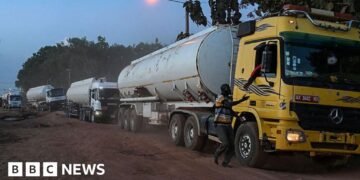
Niger has taken decisive action to revoke the licenses of multiple transport operators and drivers who have refused to deliver fuel to Mali, heightening tensions in a region already grappling with jihadist threats. This significant move arises as Mali faces a fuel supply crisis exacerbated by attacks on petrol tankers by militant groups.
This development underscores the precarious security landscape in West Africa, where economic warfare is increasingly being used as a tool by militant factions. The blockade has profound implications not only for Mali’s energy stability but also for the broader regional dynamics, influencing international travel advisories and security assessments.
Key Developments
- Niger has revoked the licenses of 14 transport operators and 19 drivers due to their refusal to transport fuel to Mali.
- A total of 82 fuel tankers were delivered to Mali by Niger last November, stabilizing energy supplies temporarily.
- The militant group Jama’at Nusrat al-Islam wal-Muslimin (JNIM) has intensified its blockade, expanding its economic strategy.
- Mali’s military government has faced ongoing security challenges since a coup in 2020.
Full Report
Immediate Government Actions
Officials in Niger’s transport ministry cited serious legal violations as the basis for revoking the licenses. Transport Minister Abdourahamane Amadou declared that those penalized must surrender their transport-related documentation. One transport operator has been handed a one-year suspension for their actions.
Jihadist Threats and Blockades
The renewed threats from JNIM have made the transport of fuel particularly treacherous, as convoys traveling from Niger to Mali—a distance of approximately 1,400 kilometers—have experienced attacks even when escorted by military forces. This situation has created a significant supply issue for Mali, a landlocked nation reliant on imported fuel.
International Concerns
The ongoing fuel crisis has garnered attention from foreign governments. The United States issued travel advisories discouraging American citizens from visiting Mali, while France has also recommended that its nationals evacuate the region due to the escalating violence.
Context & Previous Events
Mali’s military government, led by Gen Assimi Goïta since his coup in 2020, first gained popular support by promising solutions to long-standing security dilemmas, including a separatist movement influenced by Tuareg groups and subsequent jihadist insurgencies. Since the withdrawal of UN peacekeeping forces and French military assistance, the junta has turned to Russian mercenaries to address ongoing instability, but substantial areas of the country remain beyond governmental control.