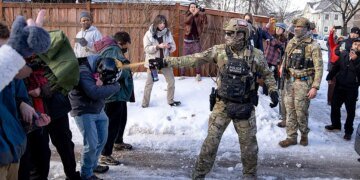























Protests in Minneapolis Escalate Amid ICE Operations, Raising Legal and Safety Concerns
As protests against U.S. Immigration and Customs Enforcement (ICE) intensify in Minneapolis, a national protest-organizing firm’s CEO has raised alarms about the legality and safety of these demonstrations. Adam Swart of Crowds on Demand has stated that his organization will refrain from involvement due to ongoing illegal activities, such as blocking roads and hindering federal agents’ operations.
Why It Matters
The unrest comes in the wake of a fatal shooting during an ICE operation, an incident that has sparked heightened tensions between protesters and law enforcement. The consequences of these protests extend beyond local disruptions, potentially affecting immigration enforcement policies and community safety.
Key Developments
- Adam Swart, CEO of Crowds on Demand, declared his firm will avoid the Minneapolis protests due to illegal actions.
- Protests erupted following the shooting of 37-year-old Renee Nicole Good during a federal operation.
- Swart criticized the mixing of peaceful demonstrators with more aggressive agitators, labeling them as a risk to public safety.
- He emphasized that blocking streets poses dangers not only to law enforcement but also to emergency services.
- Homeland Security Secretary Kristi Noem described the situation as increasingly volatile and detrimental to community order.
Full Report
Legal Violations in Protests
Swart made clear that activities such as road blockages and confrontations with officers are illegal and compromise safety. He pointed out that such tactics ultimately dilute the intended messages of the protests, stating, "When protesters commit illegal activity, what’s lost is the substance of the message." He warned that rather than decreasing ICE operations, the demonstrations may provoke a stronger federal presence.
Dangers of Escalating Tensions
He noted the chaotic environment in Minneapolis, emphasizing the presence of agitators who he characterized as unstable and a threat to peaceful protesters. According to Swart, the combination of snowy and icy road conditions further complicates the situation, making any blocking of roadways particularly hazardous.
Emergency Services at Risk
Swart voiced concerns that disruptions caused by protests hinder not only law enforcement but also essential emergency services. "When roads are blocked, who else can’t get through? Ambulances. Fire trucks," he asserted, highlighting the critical nature of maintaining accessible roadways.
Aftermath of the Shooting
The demonstrations were ignited by a confrontation involving ICE agents and Renee Nicole Good, who allegedly attempted to use her vehicle as a weapon against federal officers. The incident led to her being shot in self-defense by an ICE agent. Secretary Noem referred to the shooting as "preventable" and indicated that actions by protesters escalated tensions during the enforcement operation.
The Path Forward
Swart indicated that despite the current unrest, there remains a potential path for recovery in Minneapolis. He urged community members to reject intimidation and embrace lawful approaches to advocacy. "This can be your rock bottom," he urged, emphasizing the need for courage to improve city safety and order.
Context & Previous Events
The protests followed a police encounter in which Good was shot while ICE agents conducted enforcement operations. The situation is under investigation as local leaders grapple with the implications of heightened tensions and law enforcement’s role in urban areas. Swart has previously offered Minneapolis leaders an opportunity to engage in lawful campaigns aimed at improving community safety, but noted that fear has impeded those discussions.






