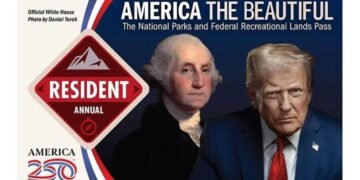























The Controversial Design of the 2026 America the Beautiful Pass
The National Park Service’s latest annual “America the Beautiful” pass has ignited considerable backlash due to its unconventional design featuring portraits of Presidents George Washington and Donald Trump, rather than the traditional natural imagery. This shift has prompted protests, sticker campaigns, and a lawsuit from an environmental group, highlighting the tension between political symbolism and the ideals of public lands.
The introduction of a political figure on a conservation-related pass raises questions about the role of national parks as nonpartisan spaces. With the annual pass aimed at promoting access to over 2,000 federal recreation sites, the controversy underscores a larger discussion about the intersection of politics and public lands in the United States.
Key Developments
- The 2026 America the Beautiful pass prominently features portraits of Presidents Washington and Trump.
- Park visitors have responded by covering Trump’s image with stickers, leading to an updated policy from the National Park Service.
- A lawsuit has been filed by the Center for Biological Diversity seeking to revert the design to a winning image from a national parks photo contest.
- Park officials will now assess whether passes are “defaced” based on visible alterations, including stickers.
Full Report
New Design Generates Backlash
The recent introduction of the 2026 annual pass marks a departure from the traditional display of natural landscapes or wildlife. Instead, the design features side-by-side portraits of Presidents George Washington and Donald Trump, inciting criticism from many park visitors. In response, many individuals have taken to social media, sharing images of their passes that are adorned with stickers covering Trump’s face. Some have completely obscured the card with their protest art, a trend aided by Jenny McCarty, a park volunteer selling custom stickers for conservation efforts.
Updated National Park Service Policy
Amidst the rising tide of protests, the National Park Service modified its policy regarding pass alterations. An internal communication revealed that passes might be deemed invalid if “defaced or altered,” specifically including stickers. The agency contends that this clarification was necessary and has consistently upheld that passes can be voided if any part is altered. Park officials now have discretion in determining whether a pass has been altered, which has raised concerns among pass holders regarding potential policy enforcement.
Legal Action and Community Response
The Center for Biological Diversity has formally filed a lawsuit, arguing that the new design contravenes federal requirements mandating that the pass showcase a winning photograph from a national park photo contest. This lawsuit seeks not only to remove the controversial design but also to prevent future political images on the passes. Kierán Suckling, the group’s executive director, cited a “pattern of Trump branding” in government materials as part of the issue.
Support and Dissent
Contrastingly, some individuals, including officials like Vince Vanata, chair of the Park County GOP, defended the change. He emphasized that the portrayal of both past and current presidents is a fitting tribute to the upcoming 250th anniversary of the United States. On the other hand, some parkgoers, such as Erin Quinn Gery, expressed strong disapproval of the design, comparing it to a devaluation of the natural beauty that national parks represent.
Context & Previous Events
Traditionally, the America the Beautiful pass has showcased picturesque views and wildlife since its inception in 2004, with images selected through public contests. Previous pass designs prominently featured stunning landscapes and iconic creatures, with past winners like those from Arches National Park and bison roaming in scenic settings.






