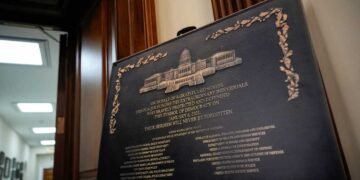























Senate Moves to Honor Capitol Police on January 6 Anniversary
In a significant bipartisan decision, the Senate has approved the installation of a plaque commemorating the bravery of law enforcement officers who defended the Capitol during the January 6, 2021, insurrection. This resolution came after growing concerns regarding the absence of the plaque, which was authorized over three years ago, and reflects an ongoing commitment to recognizing the actions of those who safeguarded democracy on that day.
Why It Matters
The decision to install the plaque has immense importance, both as a tribute to the officers who faced violence and as a counter-narrative to recent attempts to downplay the events of January 6. By highlighting the heroism of those who defended the Capitol, lawmakers aim to reaffirm a shared history and honor the process of peaceful power transfer in America.
Key Developments
- The Senate swiftly approved the resolution to install the plaque, with no objections from Senators.
- Republican Senator Thom Tillis of North Carolina, alongside Democratic Senators Jeff Merkley and Alex Padilla, was instrumental in pushing for the plaque’s installation.
- The plaque, intended to be located at the Capitol’s West front, will now be displayed in a publicly accessible area of the Senate wing until a permanent location can be established.
- There are ongoing disputes regarding the plaque’s design, as House Speaker Mike Johnson claims it does not comply with existing law.
- Trump’s White House has been criticized for shifting blame regarding the January 6 events, prompting calls for maintaining an accurate historical account.
Full Report
In remarks made during this week’s fifth anniversary of the Capitol siege, Senator Tillis emphasized the importance of honoring law enforcement’s role by stating that although January 6 was deemed a "dark day for democracy," much credit is due to the police for restoring order and enabling Congress to fulfill its constitutional duties.
Tillis recounted witnessing the violent siege and branded those involved as "thugs," contrasting their actions with the dedication shown by law enforcement that day. "We owe them eternal gratitude," Tillis stated, insisting that the nation is stronger due to their efforts.
As senators learned that the plaque authorized in 2020 was still undisplayed, many House members took the initiative to create replicas outside their offices. The Senate’s actions appear largely motivated by a backlash against recent revisions of the narrative surrounding the events of January 6 by former President Trump and his allies. During a recent speech, Trump suggested he only intended for his supporters to peacefully march, attempting to redirect blame toward Democrats and law enforcement.
Senator Merkley strongly asserted the importance of being truthful with the public about the events of January 6, calling for recognition of those who defended the nation. Senator Padilla expressed his concerns over the White House’s recent endeavors to rewrite history, noting that they "dishonor" the memories of the officers involved.
The legislation mandated the plaque’s installation at the Capitol in 2023, and the new resolution directs the Architect of the Capitol to locate it in a prominent place within the Senate wing until a permanent spot can be found. However, placing the plaque in its original location requires an agreement with the House of Representatives.
The controversy surrounding the plaque’s construction has led to police lawsuits demanding its display. Complications have arisen due to the law stipulating that the plaque should honor all officers involved, whereas the current version lists only the various law enforcement agencies that responded during the attack. Future plans include a digital component to provide further recognition, with many officers’ names expected to be included.
Context & Previous Events
The plaque commemorating the January 6 attack on the Capitol was officially approved by Congress over three years ago. Its intended placement at the Capitol’s West front was mandated to occur in 2023, a year after the legislation passed. Recent public statements from Trump and governmental reactions have contributed to shifting narratives about the day’s events, leading to increased scrutiny regarding the representation of such a pivotal moment in American history.






