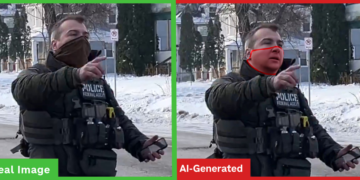























AI Manipulation Sparks Outcry Over ICE Agent’s Image
A recent incident following the fatal shooting of Renee Nicole Good in Minneapolis has highlighted the dangers of artificial intelligence in circulating misleading images. An AI-generated depiction of the masked ICE agent involved has raised concerns about misinformation and public backlash against innocent individuals.
Why It Matters
This situation underscores the potential for AI technologies to mislead the public by fabricating realistic but false identities. Misidentifications not only threaten reputations but also can have broader implications for community trust and safety. This incident illuminates a pressing need for responsible use of AI in media.
Key Developments
- An ice agent involved in the fatal shooting of Renee Good was recorded wearing a mask during the incident.
- Users on social media requested AI chatbot Grok to "unmask" the agent, resulting in a digitally altered image that spread rapidly online.
- The generated image incorrectly identified the agent as “Steve Grove,” stirring anger towards two unrelated individuals sharing the name.
- The Minnesota Star Tribune issued a statement cautioning against a coordinated disinformation campaign surrounding the agent’s identity.
Full Report
Incident Overview
The shooting of 37-year-old Renee Nicole Good occurred in Minneapolis, prompting immediate public interest and outcry. Eyewitness videos captured the chaos, featuring a masked ICE agent involved in the incident. Within hours, images began circulating on social media, misleadingly depicting the agent as unmasked.
Role of AI
According to experts, the use of AI to "unmask" individuals is fraught with risks. Hany Farid, a professor specializing in digital image analysis at UC Berkeley, noted that AI enhancements often produce what he termed "hallucinated" images, which may appear clear but lack factual accuracy concerning biometric identification. Despite these warnings, an AI-generated image with the name “Steve Grove” began to circulate.
Reaction and Misinformation
The wrongful attribution of the name led to significant backlash against at least two unrelated Steve Groves. One is a gun shop owner in Missouri, Steven Grove, who expressed frustration, stating he had no connection to the incident: "I never go by ‘Steve,’ and of course, I’m not in Minnesota." The other is the publisher of the Minnesota Star Tribune, who also found their name dragged into the controversy. The newspaper issued a statement advising the public to rely on trained journalists for factual information rather than potentially misleading AI outputs.
Official Identification
Following the confusion, news outlets and authorities clarified that the ICE agent involved in the shooting was actually named Jonathan Ross. Court documents revealed that Ross had a history of being physically assaulted during a separate traffic stop.
Context & Previous Events
This incident comes in the wake of numerous cases where misinformation has proliferated online, often exacerbated by quick-fire social media sharing and AI technology. The Minnesota Star Tribune noted the impact of coordinated disinformation campaigns and called for caution in interpreting images and information circulated online.
As this case illustrates, the intersection of AI technology and journalism necessitates vigilant scrutiny to prevent the spread of false narratives.






