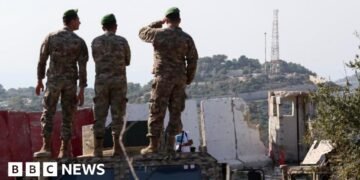























Lebanese Army Claims Control in Southern Region Amid Tensions with Hezbollah
The Lebanese army has asserted its authority over security in southern Lebanon, an area long influenced by the Iranian-backed militia Hezbollah. This development arrives against a backdrop of escalating tensions with Israel, raising concerns about a potential military escalation in the region.
Why It Matters
This shift in control is crucial as Lebanon faces intense international pressure, particularly from the United States, to disarm Hezbollah. The Lebanese army’s actions may signal a pivotal moment for Lebanon, with implications for regional security, particularly in light of recent military engagements between Israel and Hezbollah.
Key Developments
- The Lebanese army claims it has successfully established security in the south, an area previously dominated by Hezbollah, as part of a government-backed initiative.
- The army’s goal was to eliminate non-state weapons south of the Litani River, about 20 miles from the Israeli border.
- Israeli Prime Minister Benjamin Netanyahu characterized this development as a positive initial step but noted that more needs to be done due to Hezbollah’s ongoing rearmament efforts.
- Lebanese soldiers have begun dismantling infrastructure in areas once controlled by Hezbollah, with minimal resistance, according to the military.
- Despite a ceasefire, Israel has continued military operations against what it claims are Hezbollah positions, leading to ongoing tensions.
- Lebanon’s President Joseph Aoun opposes the use of force against Hezbollah, citing potential sectarian violence.
Full Report
Security Strategy in the South
The Lebanese army announced its achievement in establishing security in the southern region, an area historically influenced by Hezbollah. This step is integral to a broader plan aimed at disarming non-state armed groups in the country. Officials stated that while initial objectives have been fulfilled, efforts to address unexploded ordnance and underground tunnels remain ongoing.
Israeli Response
Israel responded to the Lebanese army’s declaration by expressing skepticism. Netanyahu’s office highlighted Hezbollah’s alleged attempts to rearm with support from Iran, indicating that current developments are insufficient to address the ongoing threat. Israeli media have reported a possible increase in military operations against Hezbollah, reportedly authorized by U.S. President Donald Trump.
Local Sentiments
While Lebanese soldiers initiated dismantling operations in regions once dominated by Hezbollah, the group claims it has complied with ceasefire terms and withdrawn its forces from specific areas. However, U.S. and Israeli officials have voiced concerns regarding the pace of the Lebanese army’s disarmament efforts, accusing Hezbollah of trying to restore its military capabilities.
Challenges Ahead
The Lebanese army faces significant challenges moving forward, particularly concerning limited funding and resources. The next phase of disarmament efforts will target the area between the Litani and Awali rivers, including the city of Sidon. There is no specified timeline, and growing financial constraints complicate these ambitions further.
Hezbollah’s Role
Although Hezbollah maintains a robust presence in various regions of Lebanon, including the eastern Bekaa valley and southern suburbs of Beirut, it has resisted calls for comprehensive discussions about disarmament. President Aoun cautioned against using force, wary of reigniting sectarian tensions within the diverse Lebanese populace.
Context & Previous Events
Lebanon has faced mounting international pressure since the ceasefire deal in November 2024, following a year-long conflict with Israel, aimed at dismantling Hezbollah. The Lebanese government denies Israeli accusations of Hezbollah rebuilding its military infrastructure, contending that Israel’s operations violate the ceasefire terms.
Amidst ongoing disputes, significant portions of the population in southern Lebanon remain displaced, while communities continue to suffer from the devastation of past conflicts. International partners have conditioned reconstruction funding on taking action against Hezbollah, underscoring the complex dynamics at play in the region.