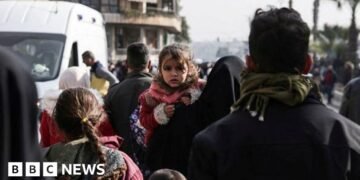























Aleppo Sees Deadly Clashes as Thousands Flee Amid Government Offensive
Intense fighting in Aleppo has resulted in at least 12 fatalities, as the Syrian government launched strikes against Kurdish-controlled neighborhoods. This escalation has forced tens of thousands of residents from their homes, highlighting the ongoing volatility in the region.
Why It Matters
The situation in Aleppo underscores the fragile state of security in Syria, particularly as Kurdish-led forces maintain significant control in the north. The clashes not only threaten the residents’ safety but complicate existing political agreements aimed at stabilizing the region, potentially impacting international relations, especially with neighboring Turkey.
Key Developments
- At least 12 individuals have reportedly died in two days of clashes between Syrian government troops and Kurdish fighters.
- Tens of thousands of civilians have fled from the Kurdish-majority neighborhoods of Sheikh Maqsoud and Ashrafieh.
- The Syrian army shelled these areas after labeling them as “closed military zones,” stating the operation was aimed at restoring security in response to armed attacks.
- The Kurdish-led Syrian Democratic Forces (SDF) condemned the government’s actions as an attempt to forcibly displace communities.
- Residents describe the situation as dire, with many seeking refuge in makeshift shelters.
Full Report
A Violent Escalation
Amid ongoing clashes in Aleppo, at least 12 people are confirmed dead over the last two days as Syrian government forces intensified their shelling in Kurdish-held neighborhoods. Civilians have begun evacuating the areas of Sheikh Maqsoud and Ashrafieh, with reports indicating that many have fled to nearby towns to escape the violence.
Government Perspective
The Syrian government claims its military operations are necessary to combat organized armed groups operating in these regions. It argues that the shelling formulation aims to restore order and protect its citizens.
Reactions from the Ground
Residents in Aleppo paint a grim picture of their reality. One local described the constant cycle of calm followed by sudden assaults, stating, “All my friends have left for other towns.” Another displaced resident, Samer Issa, expressed his sorrow over the situation, sharing that he has been sheltering in a mosque with his children due to the increased hostilities.
Accusations of Displacement
The Kurdish-led SDF has labeled the government’s military actions as a “criminal attempt” to displace its population. As these tensions escalate, the Kurdish forces have reiterated that they do not have military presence in Aleppo. The potential for further conflict remains high as both sides accuse each other of undermining previous agreements aimed at establishing peace.
Context & Previous Events
In March 2025, the Kurdish-led SDF, which controls large portions of northeastern Syria, signed a deal to begin integrating military and civilian institutions into the broader Syrian state. Despite this agreement, implementation has stalled, with both parties blaming each other for obstructing progress. The SDF, having gained autonomy during the civil war and aiding in the defeat of the Islamic State, remains hesitant to relinquish its control.
The conflict in Aleppo presents not just a humanitarian crisis but also risks drawing in external actors, such as Turkey, which opposes the presence of Kurdish militias it designates as terrorist groups.