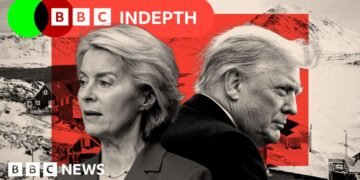























Tensions Rise Over Greenland as European Leaders Navigate U.S. Relations
European leaders gathered in Paris today amid heightened tensions over U.S. intentions regarding Greenland, a matter of significant geopolitical implications, particularly in the context of the ongoing conflict in Ukraine. As discussions aimed to solidify support for Ukraine, the U.S. administration’s recent actions have brought the sovereignty of Greenland into sharp focus.
Why It Matters
The situation reflects a broader struggle for European nations to assert their autonomy while navigating the unpredictable foreign policies of the Trump administration. As discussions on Ukraine’s future intertwine with U.S. interests in Greenland, Europe finds itself at a crossroads, testing the strength and unity of transatlantic alliances.
Key Developments
- The Paris meeting included envoys from the Trump administration, particularly special envoy Steve Witkoff and Jared Kushner, as European leaders sought to maintain U.S. support for Ukraine.
- Danish Prime Minister Mette Frederiksen faced pressure from European counterparts to avoid provoking the U.S. over Greenland, a topic that arose following Trump’s controversial remarks about the island.
- European leaders ultimately issued a joint statement asserting that "Greenland is part of NATO" and underscoring the need for collective Arctic security with U.S. involvement.
- Critics noted the statement’s limited signatories, suggesting it failed to showcase a unified European stance on Greenland’s sovereignty.
Full Report
European Leaders Navigate Pressures
At the meeting in Paris, President Zelensky of Ukraine emphasized that a peace plan with Russia was nearly finalized, suggesting that a unified stance among allies was crucial. The U.S. has recently made headlines for military actions in Venezuela and provocative comments about Greenland’s strategic value, both of which have increased tensions across the Atlantic.
Frederiksen was reminded by her colleagues that maintaining U.S. support for Ukraine is paramount. Therefore, she was encouraged to tread carefully regarding Greenland. The joint statement issued by European leaders emphasized that decisions about Greenland should rest solely with Denmark and its autonomous territory.
While Greenland’s Prime Minister Jens Frederik Nielsen welcomed the statement, it underscored a perception of slow collective action among European nations, and some analysts noted that a broader statement from all 27 EU nations would have sent a stronger message to Washington.
Irony in U.S.-Europe Relations
The meeting encapsulated an irony where European leaders, who typically advocate for independence from outside influences, found themselves battling a U.S. administration that just recently showcased its willingness to intervene in a sovereign nation’s affairs. This juxtaposition has amplified fears about the future of NATO, particularly if U.S. intentions toward Greenland materialize, threatening Danish sovereignty.
Trump’s past remarks about acquiring Greenland, whether through purchase or other means, further complicate the matter. Despite Denmark’s robust plans to bolster Greenland’s defenses, the ambiguity surrounding U.S. intentions has left many European leaders concerned about the implications for NATO unity.
Hesitant Responses from Major Powers
The reactions from larger European nations such as the UK, France, and Germany have been muted compared to Denmark’s neighboring countries, which quickly vocalized support for Copenhagen. While U.K. Prime Minister Sir Keir Starmer and German Chancellor Friedrich Merz have asserted that only Denmark can determine Greenland’s future, their responses indicate hesitance to confront the U.S. directly.
A senior EU official pointed out that the silence from Europe’s major capitals betrays a "fundamental weakness" in its relationship with the Trump administration. This caution reflects a broader trend of European nations attempting to manage their ties with the U.S., despite growing tensions.
Context & Previous Events
Recent history highlights the complexities in U.S.-European relations. The EU failed to mobilize support for Ukraine from frozen Russian assets, a missed opportunity that critics say further demonstrated the bloc’s inability to project strength. Additionally, previous encounters with tariffs under the Trump administration have shown that Europe often refrains from retaliatory actions due to fears of losing vital U.S. support.
As geopolitical tensions evolve, the situation surrounding Greenland is emblematic of the broader challenges Europe faces in asserting its position on the global stage, particularly in light of U.S. policies that can rapidly shift and influence regional dynamics.