






















Ousted Venezuelan Leader Nicolás Maduro and Wife Face Federal Charges in New York
The recently ousted Venezuelan President Nicolás Maduro and his wife, Cilia Flores, appeared in a New York federal court yesterday, where they pleaded not guilty to serious federal charges, including narco-terrorism. This significant event marks their first court appearance after being seized by U.S. military forces from Venezuela over the weekend, raising questions about U.S. intervention in foreign nations and the legal ramifications for Maduro’s government.
Why It Matters
The charges against Maduro represent a major escalation in U.S. efforts to hold foreign leaders accountable for alleged criminal activities. The implications of this case extend beyond legal proceedings, as it touches on issues of sovereignty, military intervention, and the ongoing political crisis in Venezuela. With a sharply divided opinion among U.S. lawmakers regarding the operation that led to Maduro’s capture, the unfolding situation could influence U.S. foreign policy in Latin America and the forthcoming midterm elections.
Key Developments
- Nicolás Maduro and Cilia Flores were captured by U.S. military forces and transported to New York.
- They made their initial court appearance on federal charges, including narco-terrorism, where both pleaded not guilty.
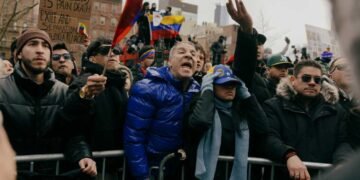
- Outside the courthouse, a mix of protesters voiced opposing views on U.S. intervention, reflecting a polarized public sentiment.
- President Trump is scheduled to meet with House Republicans today to discuss the operation and the implications for U.S. foreign policy.
- The political divide in Congress is evident, with Democrats criticizing the lack of notification to Congress prior to the military operation, labeling it an act of war.
Full Report
Maduro and Flores’s court appearance drew significant media attention, particularly when Maduro briefly acknowledged reporters, wishing them a "Happy New Year." Meanwhile, Flores was seen with visible injuries attributed to her capture, prompting concerns about the tactics used by U.S. forces during the operation.
Outside the Daniel Patrick Moynihan United States Courthouse, protests erupted between groups supporting and opposing the U.S. military intervention. One protester, Izzy McCabe, labeled the operation a means for the U.S. to exploit Venezuela’s oil and resources, while another, Maria Seu, argued that many countries have benefited from Venezuela’s wealth for years.
In Washington, President Trump is set to engage with House Republicans to discuss the operation’s details and implications, amidst ongoing concerns about the administration’s decision-making process. Lawmakers have expressed dissatisfaction regarding Trump’s failure to notify Congress before executing the military seizure, with Democrats calling it an unprecedented act of war. In contrast, Republicans have largely expressed support for the president’s approach.
Context & Previous Events
The court proceedings occur on the heels of a significant memo from Trump’s administration in December, which directed health officials to align U.S. vaccine schedules with those of other developed nations. This adjustment has sparked concerns among health experts about its potential impact on childhood vaccinations, further demonstrating the political climate surrounding the administration’s actions.
The political discourse around Maduro’s capture is enmeshed in a broader context of U.S.-Venezuelan relations, which have been strained for years amid allegations of human rights abuses and economic mismanagement under Maduro’s leadership. The charges brought against Maduro could serve as a pivotal moment in U.S. foreign policy, particularly as the nation heads toward the midterm elections, with other topics likely to surface during congressional discussions.






