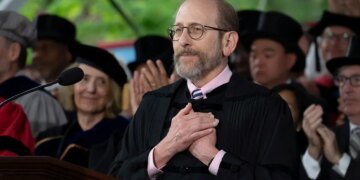























Harvard’s President Critiques Faculty Activism Amidst Concerns Over Free Speech
Harvard University President Alan Garber recently addressed issues of free speech and faculty activism at the university, contending that the current classroom climate has intimidated students from expressing opposing viewpoints. His remarks, made during an appearance on the Identity/Crisis Podcast, highlight growing concerns over ideological diversity in academia.
Why It Matters
Garber’s comments come amid rising awareness of the need for open dialogue on college campuses, particularly in relation to controversial topics like antisemitism and political discourse. As universities confront claims of biased teaching practices, Garber’s call for a return to objectivity and factual learning may influence educational policies and practices moving forward.
Key Developments
- Podcast Appearance: President Garber discussed the challenges of maintaining viewpoint diversity and the impact of faculty beliefs on student expression.
- Criticism of Activism: Garber criticized faculty who promote their personal views in classrooms, urging a more objective, fact-based approach to teaching.
- Call for Balance: He acknowledged shifts in ideological freedom at Harvard and emphasized the necessity for open dialogue and mutual respect.
- Broader Context: The school’s ongoing controversies regarding free speech and alleged biases in admissions were referenced, including a notable instance involving the Trump administration and antisemitis.
Full Report
Declining Free Speech
During the podcast, Garber pointed out that many students feel anxious about expressing dissenting opinions in classrooms dominated by faculty ideologies. He questioned whether students could effectively challenge a professor who presents a strong opinion on controversial matters, noting the apprehensive atmosphere that has developed.
Garber emphasized his belief that the primary role of higher education is to provide students with reliable information and analytical tools rather than promoting activism or specific political perspectives. He stated, "What we need to arm our students with is a set of facts and a set of analytic tools… People will do that, and we want to make sure that the education we give them will enable them to do that with some real authority."
Movement Towards Change
Garber outlined a movement within the university to restore balance in teaching, encouraging instructors to prioritize objectivity and a wide range of viewpoints. He insisted that the university’s mission requires effective communication among diverse groups, advocating for a culture where individuals can engage in potentially uncomfortable conversations.
School Policy Controversies
In recent years, Harvard has faced a storm of scrutiny over its handling of free speech issues. A 2018 incident, highlighted by Fox News Digital, showcased faculty praise for a far-left activist advocating potential political violence. This incident, among others, has intensified debate over the university’s ideological homogeneity and the establishment of admission policies allegedly discriminatory against certain demographic groups.
Context & Previous Events
In 2025, Harvard became embroiled in controversy surrounding free speech and campus radicalism. The Trump administration halted $2.7 billion in federal funding due to allegations of antisemitism, generating legal disputes. A federal court later ordered the release of funds in favor of Harvard.
Moreover, a notable recent critique from a retired professor shed light on concerns over admission practices allegedly favoring minority applicants over others, raising alarms about racial biases in academia. The professor’s claims reflect broader trends observed in many elite institutions regarding diversity and inclusiveness.
Harvard’s commitment to fostering an environment where free speech flourishes remains a critical consideration as it navigates these complex issues.






