






















Trump Launches Military Operation in Venezuela, Capturing Maduro
The United States has initiated a military operation in Venezuela, resulting in the capture of President Nicolás Maduro. This significant move, announced from Trump’s Mar-a-Lago residence, raises questions regarding U.S. foreign policy direction and its implications for domestic and international stakeholders.
Why It Matters
This operation marks a striking pivot for President Trump, who previously campaigned against foreign interventions. The geopolitical ramifications are vast, influencing not only U.S.-Venezuela relations but also affecting perceptions of American military engagement globally. Time will reveal whether this action solidifies support among Trump’s base or sparks dissent.
Key Developments
- U.S. troops conducted a night raid in Venezuela, capturing Maduro and his wife.
- Trump has stated that U.S. forces will oversee Venezuelan governance until a new leader is chosen.
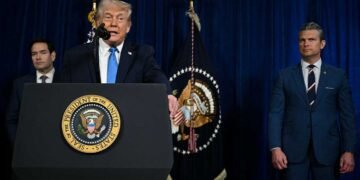
- Secretary of State Marco Rubio and Defense Secretary Pete Hegseth accompanied Trump during the announcement.
- The rationale for the operation has shifted, with emphasis on combatting drug trafficking and securing oil interests.
- Trump has faced criticism for his previous anti-intervention stance juxtaposed with aggressive military action.
Full Report
A Surprising Military Initiative
On Saturday, Trump announced an unexpected military operation in Venezuela, resulting in the arrest of Maduro and his wife, just a few months into his second term. This marks a notable departure from his previously isolationist rhetoric. Trump referred to the operation as necessary for American interests and claimed it would benefit the Venezuelan populace. He outlined plans for U.S. oil companies to modernize the country’s oil sector, insisting the “biggest beneficiaries” would be Venezuelans and their expatriates in the U.S.
Shifting Justifications for Intervention
Historical parallels have been drawn between the latest action in Venezuela and the U.S. invasion of Iraq two decades ago. Justifications for overthrowing Maduro have evolved, similar to arguments made for ousting Saddam Hussein. Trump highlighted oil interests as a primary motivator, while Rubio attempted to soften the operation’s image by labeling it a “quarantine” to implement policy changes.
Recent comments from U.S. officials suggest that combating drug trafficking is at the forefront of the administration’s rationale, despite limited evidence linking Venezuela to fentanyl production. The White House defended the operation amid bipartisan discussions regarding its legality and implications for U.S. foreign policy.
Growing Role for Rubio
Marco Rubio appears to be gaining significant influence within Trump’s inner circle, taking on various roles in the administration. His hawkish stance on issues concerning Latin America is evident as he actively participated in public defense of the operation, demonstrating increased sway over foreign policy decisions.
Critique of Foreign Policy Standards
The administration has faced scrutiny over its selective approach to dictatorships, questioning why certain regimes are targeted while others are not. Trump’s relationships with authoritarian leaders globally raise concerns about inconsistency in U.S. foreign policy priorities.
Reactions from Republicans and Democrats
While some in Trump’s base have expressed skepticism regarding intervention, support remains strong among many Republicans. Meanwhile, Democrats face a delicate balancing act in their response, wary of appearing to defend Maduro or downplaying the military operation’s seriousness. Criticism from House Minority Leader Hakeem Jeffries noted the potential for Congress to reassert control over military action.
Context & Previous Events
Prior to this operation, public sentiment regarding military intervention in Venezuela was tepid, with significant opposition documented in polls. Critics of U.S. intervention often reference the nation’s mixed history with regime changes in Iraq and Libya. Trump’s conduct in foreign affairs has raised questions about his administration’s strategy for the post-operation landscape in Venezuela, emphasizing the need for a clear plan moving forward.






